

Sardinia’s seismic activity is shaped by a complex geological history, including past major earthquakes in 1616, 1771, and recent minor events. Modern monitoring uses advanced sensors to detect low-magnitude quakes, though noise from wind and industry can complicate this. The island’s tectonic setting involves ongoing crustal movements and fault activity, which sometimes damage historic sites. To better understand these risks and how the island’s history influences current hazards, you’ll find plenty more insights ahead.
Key Takeaways
- Sardinia experiences low seismic activity, with historical and modern records primarily documenting minor to moderate earthquakes.
- Significant past events include offshore quakes up to magnitude 5.1, with recent assessments indicating low hazard levels.
- Tectonic processes, such as crustal rotation and fault reactivation, influence ongoing seismicity in the region.
- Advanced seismic monitoring techniques help distinguish true earthquakes from noise, ensuring accurate detection and analysis.
- Cultural heritage sites are vulnerable to earthquakes, emphasizing the need for integrated hazard assessment and preservation efforts.
Historical Earthquake Records and Notable Events

Historical earthquake records in Sardinia reveal a pattern of rare but notable seismic events. You’ll find three major earthquakes highlighted in 1616, 1771, and during the 1948–1949 sequence, with the 1948 offshore quake reaching magnitude 5.1. This offshore event remains the strongest recorded near Sardinia until 2011. Records also show a seismic sequence in early 1901, recently re-evaluated to identify a main shock. Many older reports, like those from 1835, 1838, 1855, and 1898, are now considered doubtful or fictitious after reassessment. Low-magnitude events in 1870, 1906, 1922, and 1924 had minimal or no macroseismic effects. Overall, Sardinia’s seismicity is sparse, with most earthquakes causing limited damage and showing a pattern of minor ground shaking. The region’s seismic hazard remains low but is not negligible, emphasizing the importance of continued monitoring and research.
Modern Seismic Activity and Instrumental Monitoring
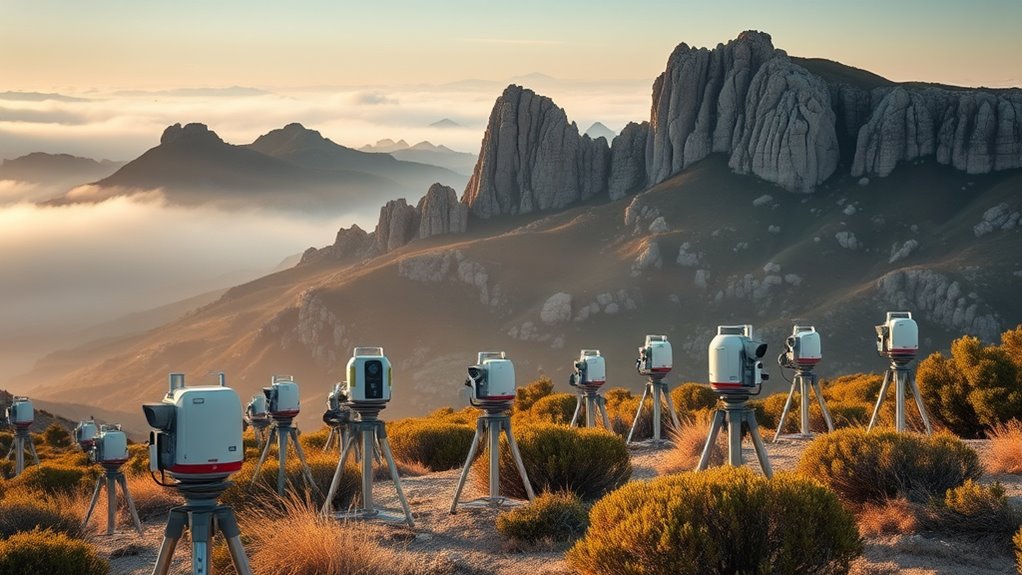
Modern seismic monitoring in Sardinia relies on advanced instrumentation to capture ground movements with high sensitivity, even in remote areas. Broadband seismic stations are deployed in arrays to continuously record ground motion, distinguishing natural signals from anthropogenic noise. For example, wind turbines at Buddusò–Ala dei Sardi generate spectral peaks at specific frequencies, affecting nearby sensors. To mitigate this, seismic noise characterization and data processing techniques like spectral analysis are employed. These methods help identify noise sources and monitor temporal changes in the ambient seismic field. The following table highlights key aspects:
| Aspect | Description | Impact |
|---|---|---|
| Instrumentation | Broadband stations, DAS, borehole sensors | Enhanced detection of microseismicity |
| Noise Sources | Wind turbines, industrial activities | Need for noise mitigation |
| Data Analysis | Spectral, polarization, PSD techniques | Accurate earthquake identification |
| Monitoring Goals | Site stability, background activity | Infrastructure safety, research |
| Network Integration | Geophysical observatories, regional networks | Improved hazard assessment |
Furthermore, understanding the spectral features generated by wind turbines allows researchers to develop more effective filtering methods, thereby improving the detection of natural seismic events amidst anthropogenic noise. Additionally, advancements in instrumentation such as fiber-optic sensors contribute to more precise ground motion recordings, enhancing overall seismic hazard assessments.
Geological Setting and Tectonic Influences

The geological setting and tectonic influences of Sardinia are shaped by its position within the Sardinian-Corsican Block, a distinct tectonic unit that detached from the European mainland around 21 million years ago and migrated into the Mediterranean. During its movement, the block rotated 50°-60°, with southern Sardinia experiencing up to 120° of rotation over millions of years, creating complex structural settings. Sardinia’s basement consists of Variscan rocks overlain by Mesozoic carbonate and siliciclastic sequences, reflecting diverse tectonic histories. Tectonic processes, including early Miocene separation, regional compression, and extensional phases like the formation of the Campidano half-graben, have shaped its crust. These motions reactivated faults, influenced seismicity, and contributed to the island’s varied geology and landscape. Tectonic shifts have also led to the development of large fault systems that continue to influence present-day seismic activity across Sardinia. Additionally, the ongoing fault reactivation underlines the importance of understanding the island’s seismic risk and geological evolution.
Impact on Cultural Heritage and Historical Documentation
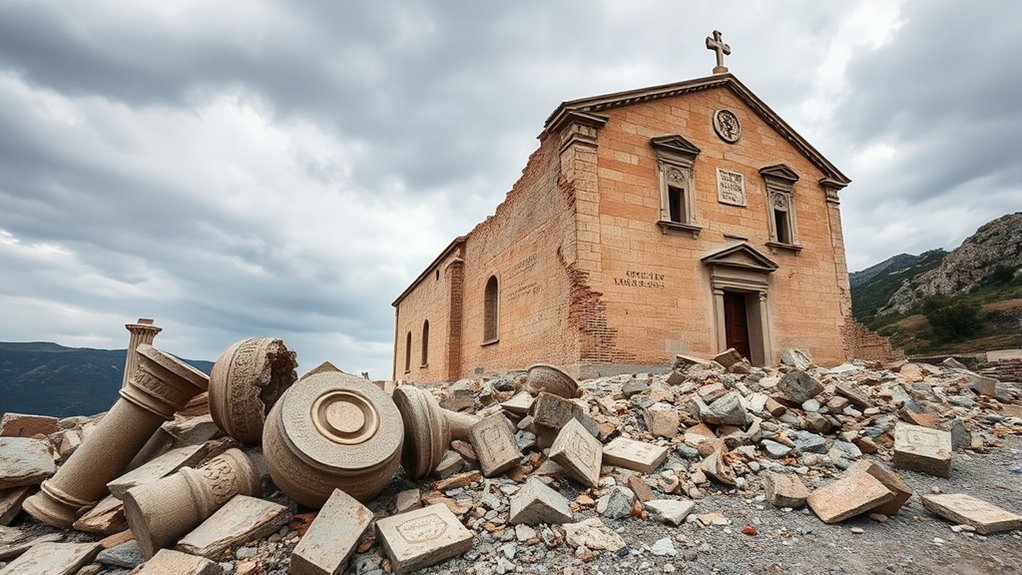
Seismic events in Sardinia have caused notable damage to its cultural heritage, threatening historic structures such as churches, watchtowers, and other landmarks essential to local identity. Past earthquakes, like the 1616 event near Cagliari, weakened coastal watchtowers and caused structural damage. Damage includes collapse, loss of original features, and deterioration of irreplaceable sites. These earthquakes also prompt urgent documentation efforts, capturing images and records to aid restoration and future risk mitigation. Organizations like ICCROM help preserve these records globally. However, historical earthquake data in Sardinia remains incomplete, complicating thorough assessments. Restoring damaged sites requires specialized skills, balancing safety with preservation. Limited resources, especially in rural areas, challenge timely repairs. Protecting heritage is crucial for maintaining community identity amid ongoing seismic risks. Additionally, understanding the seismic activity patterns in the region can improve preparedness and resilience strategies.
Assessing Seismic Hazard and Future Risks

Despite Sardinia’s reputation for low seismic activity, evaluating its future earthquake risks remains important. While the island is mostly stable, historical data show occasional moderate events, especially offshore. Probabilistic models like MPS19 confirm very low probabilities of strong shaking but highlight the non-zero risk of moderate earthquakes. Faults are poorly mapped, and seismic sources are limited, making hazard assessments rely on indirect geological evidence. Future risk evaluations should incorporate uncertainties from sparse data and reexamine historical events. This approach ensures a cautious perspective on potential hazards. Seismogenic zoning and data integration from recent models further support the understanding of regional seismicity patterns.
Frequently Asked Questions
How Do Sardinian Earthquakes Compare to Other Italian Seismic Regions?
You might wonder how Sardinian earthquakes compare to other Italian regions. Sardinia experiences about 7 earthquakes annually, mostly weak and offshore, with very rare events above magnitude 5. In contrast, mainland areas like Sicily and Marche see hundreds of tremors each year, often stronger and more damaging, due to active tectonic faults. Sardinia’s seismic risk remains low, but occasional earthquakes remind you that no place is entirely free from seismic activity.
What Are the Main Challenges in Reconstructing Sardinia’s Seismic History?
Reconstructing Sardinia’s seismic history is challenging because the region has limited documented earthquakes and scarce physical evidence. You’ll find it hard to differentiate seismic damage from natural or human-made effects, especially given the complex geology and sedimentary features. The stable tectonic setting and rare events mean fewer clues, so you must rely on indirect indicators and multidisciplinary approaches, which adds uncertainty to your reconstructions.
Are There Any Active Faults Currently Identified on Sardinia?
You might think Sardinia’s faults are hiding, but the truth is, no active faults have been identified there. The island sits on a stable microplate, far from major tectonic boundaries. Most seismic activity is low-magnitude and scattered, linked to ancient or minor faults rather than active ones. Modern geophysical studies confirm Sardinia’s tectonic stability, reinforcing that no significant faults currently pose a seismic risk on the island.
How Does Sardinia’s Seismic Risk Influence Local Building Codes?
Your question about how Sardinia’s seismic risk influences local building codes highlights the region’s low hazard level. Because of this, codes require minimal seismic design features compared to higher-risk areas. You’ll notice fewer restrictions on building height and reinforcement, with standards mainly ensuring basic structural integrity. While retrofitting older buildings isn’t always mandated, ongoing monitoring and risk assessments help keep construction safe without overly strict regulations.
What Future Research Is Planned to Better Understand Sardinian Seismicity?
You’ll see that future research in Sardinia focuses on detailed geognostic and geophysical surveys near the Sos Enattos mine, aiming to identify most favorable sites for the Einstein Telescope. These efforts include analyzing soil properties, seismic noise from wind farms, and building advanced facilities for high-resolution seismic monitoring. By integrating multidisciplinary studies, scientists seek to better understand regional seismicity, improve early warning systems, and develop innovative detection technologies.
Conclusion
As you explore Sardinia’s seismic story, you see a land shaped by restless tectonic forces, like a sleeping giant with a fierce heartbeat. While history whispers warnings and modern tools listen closely, the island’s future remains a dance with the earth’s unpredictable rhythm. Stay vigilant, for understanding these tremors is your key to safeguarding its vibrant culture and timeless beauty, ensuring Sardinia’s soul endures beyond the shaking shadows.


