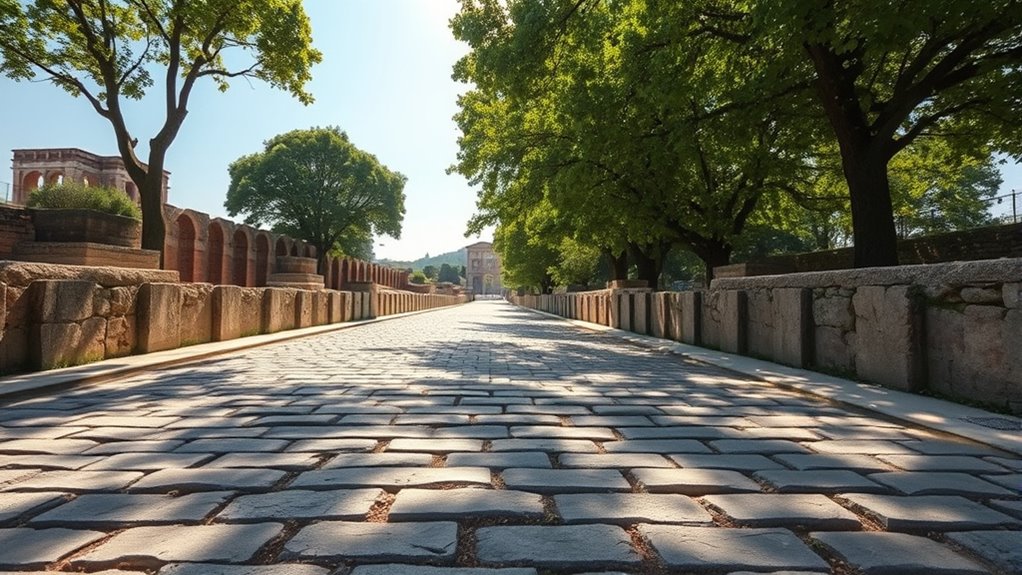

Ancient Roman roads are true engineering marvels, showcasing careful planning, advanced surveying tools, and durable construction methods. You’ll see how they prioritized direct routes, overcame natural obstacles, and used layered foundations with tightly fitted stones for long-lasting durability. Drainage played a essential role, with water management features ensuring roads remained intact for centuries. If you keep exploring, you’ll uncover the ingenious techniques that made these roads some of the most enduring structures ever built.
Key Takeaways
- Roman roads were strategically planned for directness, safety, and efficiency using surveying tools like groma and chorobates.
- They featured layered construction with foundations, compacted gravel, and durable stone surfaces for longevity.
- Drainage systems, including ditches and a slight camber, prevented water damage and extended road lifespan.
- Natural materials such as stone and gravel, combined with precise layering, contributed to their durability.
- The sophisticated engineering techniques allowed Roman roads to withstand centuries of use and remain foundational to modern routes.
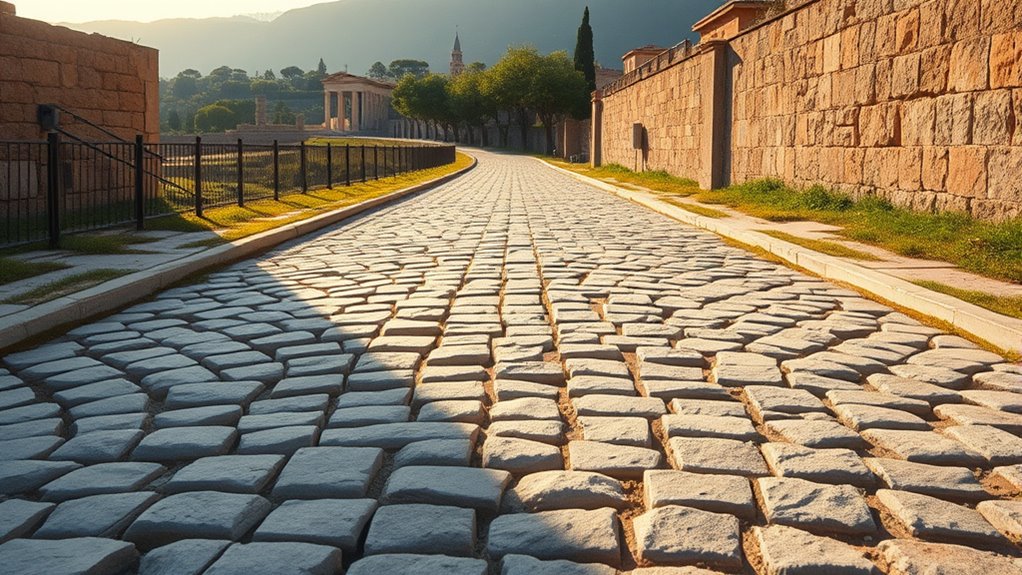
Have you ever wondered how the ancient Romans managed to build such an extensive and durable network of roads? It’s a demonstration to their advanced engineering skills and meticulous planning. The secret lies in their innovative construction techniques and strategic route planning, which together created a system that lasted for centuries.
When you look at Roman roads, you’ll notice that they weren’t built haphazardly. Instead, they followed carefully planned routes that connected essential military, commercial, and administrative centers across the empire. The Romans prioritized directness and efficiency, often choosing the shortest and safest paths, which involved surveying landscapes and overcoming natural obstacles. Their route planning was precise; they used tools like groma and chorobates to measure straight lines and level surfaces, ensuring that roads remained as direct as possible.
Roman roads followed precise, carefully planned routes connecting key centers across the empire.
The construction techniques employed by the Romans were equally impressive. Once a route was established, they began by clearing and leveling the ground. To guarantee durability, they layered their roads with several materials. First, a foundation of large stones was laid down to provide stability. On top of that, they added crushed stones or gravel, compacted meticulously to prevent shifting. Above this, a layer of sand or fine gravel was spread, creating a smooth and firm base. Finally, the surface was paved with tightly fitted stones or slabs, often arranged in patterns that prevented movement and provided a sturdy walking and riding surface.
What set Roman roads apart was their attention to drainage. They incorporated slight camber—a gentle arch—so water would run off efficiently, preventing damage from water pooling. Drainage ditches and culverts were strategically placed along the route, keeping the roadbed dry and extending its lifespan. This careful planning minimized erosion and decay, making Roman roads some of the most durable structures of their time. Additionally, the use of natural materials like stone and gravel contributed significantly to their longevity.
The combination of clever route planning and advanced construction techniques allowed the Romans to build roads that weren’t just functional but also long-lasting. Their roads could support heavy traffic, from chariots to armies, and many still form the basis of modern routes today. So, when you think about the engineering marvels of ancient Rome, remember that it wasn’t just their grand designs but their meticulous planning and innovative building methods that made their roads stand the test of time.

Goldblatt Concrete Tools Include Edger (6" x 3", 1/4"R) and Groover (6" x 3", 1/2"W, 1/2"D), Stainless Steel Concrete Finishing Tools – Masonry Hand Tool Set, Cement Finishing Kit with Soft Grip
- Material: Stainless steel for durability and corrosion resistance
- Agile Design: Compact size for delicate projects
- Concrete Edger: Polished weld joints for smooth edges
As an affiliate, we earn on qualifying purchases.
As an affiliate, we earn on qualifying purchases.
Frequently Asked Questions
How Did Roman Roads Influence Modern Road Construction Techniques?
Roman road design influences modern roads by inspiring durable and efficient construction methods. You can see their impact in layered road structures and precise surveying techniques. Asphalt innovations today draw from Roman practices of creating smooth, long-lasting surfaces. Their focus on engineering precision and material use set a foundation for modern roadbuilding, ensuring roads are resilient and easy to maintain, shaping how you experience transportation every day.
Were Roman Roads Built for Military or Civilian Purposes?
You should know that Roman roads were primarily built for military purposes, enabling rapid troop movement across the empire. However, they also served civilian needs, like facilitating trade routes and communication. The engineering purposes behind their construction guaranteed durability and efficiency, supporting both military campaigns and economic growth. So, these roads were essential for maintaining control and boosting commerce, reflecting their dual role in Roman society.
What Materials Were Primarily Used in Roman Road Construction?
You should know that Roman roads were primarily built with a durable core of Roman concrete, which guaranteed long-lasting road surface durability. The Romans used layers of gravel and stones, topped with tightly fitted paving stones, to create a sturdy, resilient surface. This combination allowed the roads to withstand heavy traffic and harsh weather, showcasing their advanced engineering skills and contributing to the empire’s connectivity and efficiency.
How Long Did Roman Roads Typically Last Before Needing Repairs?
Roman roads typically lasted for decades, often up to 50 or more years, before requiring repairs. Their durability depended on construction quality and maintenance practices. You’d find that well-maintained roads remained functional longer, thanks to regular upkeep like patching and resurfacing. The Romans prioritized maintenance, ensuring roads stayed durable for trade, military movement, and daily travel, which contributed greatly to their impressive longevity and ongoing usefulness.
Are Any Roman Roads Still in Use Today?
Yes, you can still walk along some Roman roads today. Roads like the Appian Way are prime examples of road preservation, maintaining their historic charm while serving modern travelers. These routes connect archaeological sites, allowing you to explore ancient history firsthand. Their enduring construction proves how Roman engineering has stood the test of time, blending historical significance with functional use, and offering a tangible link to the past for you to experience today.
surveying instruments groma chorobates
As an affiliate, we earn on qualifying purchases.
As an affiliate, we earn on qualifying purchases.
Conclusion
You might think Roman roads were just for travel, but some experts believe they also served military and political purposes, ensuring swift troop movements and control. Their engineering brilliance isn’t just about longevity; it might have been a strategic move to maintain power across the empire. So, next time you walk on a modern road, remember, the Romans possibly used roads to wield influence as much as to connect. Their roads truly were engineering marvels with hidden, strategic depths.

Givenni Architecture The Roman Colosseum Building Sets; Collectible Model for Adults; Home Décor Model Building Kit, Creative DIY Activity, Famous Landmarks Collection (3989Pieces)
- Piece Count: 3989 pieces for detailed assembly
- Easy Installation: Step-by-step instructions included
- High-Quality Blocks: Realistic and durable building bricks
As an affiliate, we earn on qualifying purchases.
As an affiliate, we earn on qualifying purchases.

ZL190PLUS Land Surveying Equipment, Handheld GPS for Surveying with 3.2 Inch Color Screen, Multi-GNSS Support, 7 Measuring Models for Measuring Land Area, Length,Slope and Save Coordinates Points
- Large Sunlight-Readable Screen: 3.2-inch color display with high resolution
- Professional Multi-GNSS Support: Supports GPS, Beidou, Galileo, GLONASS, NAVIC, QZSS
- High Precision Measurements: Area error < 0.002 acres, distance error < 5 ft
As an affiliate, we earn on qualifying purchases.
As an affiliate, we earn on qualifying purchases.