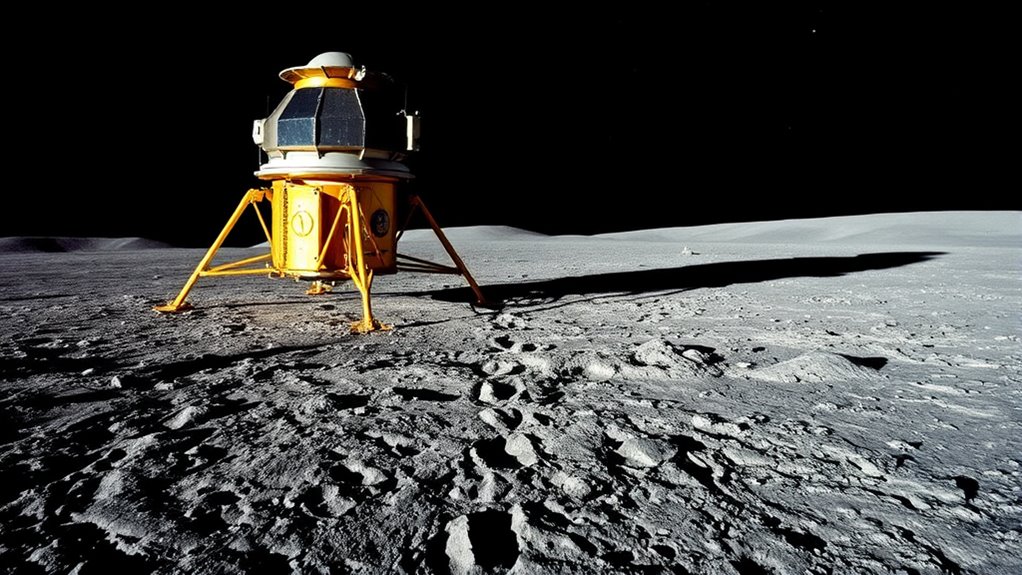

The 1969 Moon landing was a groundbreaking moment that demonstrated human ingenuity, technological innovation, and international achievement. You see, it took years of secretive research, complex engineering, and intense competition to make it happen. The feat proved that humans could explore beyond Earth, inspiring future missions and scientific progress. If you want to uncover how this historic event shaped our understanding of space and technology, there’s much more to explore.
Key Takeaways
- The 1969 Moon landing was a historic milestone demonstrating human technological and scientific achievement during the Cold War.
- NASA’s Apollo 11 mission successfully landed astronauts Neil Armstrong and Buzz Aldrin on the Moon’s surface.
- It required overcoming significant technical challenges, including spacecraft design, navigation, and survival in the lunar environment.
- The event inspired future exploration and showcased human curiosity, innovation, and perseverance.
- The Moon landing set a precedent for ongoing space exploration and advanced various scientific and technological fields.

Did you ever wonder how humans first set foot on the Moon? It’s a question that captures the imagination and reminds us of a time when space exploration was driven by intense competition and national pride. During the height of the space race, the United States and the Soviet Union vied to achieve extraordinary milestones in lunar exploration. The race wasn’t just about reaching space; it was about claiming a place in history and demonstrating technological and scientific superiority. When NASA launched Apollo 11, it marked the culmination of years of secretive research, daring engineering, and bold ambition. This mission was not only a technological triumph but also a powerful symbol of what humanity could accomplish when driven by a shared goal. You can imagine the tension and excitement surrounding the project, as every small step forward was a victory against the backdrop of Cold War rivalry.
Lunar exploration during this era was a monumental challenge. Engineers and scientists worked tirelessly to develop spacecraft capable of surviving the vacuum of space, the extreme temperatures, and the complex navigation required to land on and lift off from the Moon’s surface. When Neil Armstrong and Buzz Aldrin descended in the lunar module, they became the first humans to explore a celestial body beyond Earth. As you think about that historic moment, consider how it was the result of years of meticulous planning, innovation, and international competition. The space race pushed technological boundaries, leading to advancements that benefited many other fields, from telecommunications to materials science. The Moon landing proved that lunar exploration was no longer a distant dream but an achievable reality. Moreover, the event showcased the importance of expertise and innovation in overcoming complex engineering challenges.
You might also reflect on the broader impact of that event. The successful landing inspired generations to look beyond our planet and dream bigger. It demonstrated that with perseverance and collaboration, humans could overcome seemingly insurmountable obstacles. The Apollo mission set a precedent for future lunar missions and deep space exploration. It showed that humanity’s curiosity and desire to explore could lead to extraordinary achievements. As you consider the significance of the Moon landing in 1969, it’s clear that this moment was more than just a technical feat; it was a defining point in history that illustrated our collective potential to push the boundaries of what’s possible in the quest for knowledge and discovery.
Frequently Asked Questions
How Did the Apollo 11 Astronauts Survive the Vacuum of Space?
You survive the vacuum of space because the Apollo 11 astronauts wear space suits designed for durability and protection. These suits maintain pressure, provide oxygen, and shield you from lunar surface hazards like extreme temperatures and micrometeoroids. The suits’ advanced materials prevent the vacuum from harming your body, ensuring you stay alive and functional while exploring the moon’s surface. Proper suit design is essential for human survival beyond Earth’s atmosphere.
Were There Any Secret Missions Related to the Moon Landing?
You might have heard conspiracy theories suggesting secret space programs or covert missions related to the moon landing. However, there’s no verified evidence of secret missions connected to Apollo 11. While some believe governments hide advanced space projects, mainstream science and historical records confirm the moon landing was a public achievement. Keep a critical mind, but remember, most claims about secret moon missions lack credible proof.
What Technology Was Used to Communicate With Earth During the Mission?
You relied on advanced radio frequencies and telemetry systems to communicate during the moon landing. While the vastness of space seems silent, these technologies created a lifeline, bridging the distance between Earth and astronauts. The radio frequencies transmitted voice, data, and images, enabling real-time updates. Telemetry systems continuously sent essential information back home, ensuring mission success and safety, turning an impossible silence into a symphony of human achievement.
How Did the Moon Landing Impact Global Politics at the Time?
You see, the moon landing intensified the Cold War tensions and fueled the Space Race between the US and USSR. It proved American technological superiority, boosting national pride and diplomatic influence. The event prompted increased space exploration efforts worldwide, shaping international politics. As a result, countries invested more in science and technology, recognizing space as a new frontier for global power and competition, fundamentally changing diplomatic dynamics during that era.
Are There Still Unexplored Areas on the Moon Today?
Yes, there are still unexplored areas on the moon today. You might find lunar caves intriguing, as they could offer shelter and clues about the moon’s geology. Unexplored craters also remain, some hidden beneath lunar regolith. Scientists continue to plan missions to investigate these regions, aiming to uncover secrets about the moon’s history and potential resources. Your curiosity drives efforts to explore these mysterious, untouched lunar landscapes.
Conclusion
As you reflect on that historic day, remember how humanity gently nudged the boundaries of what’s possible. The moon’s silent embrace welcomed our curiosity, showing us that even the boldest dreams can softly bloom into reality. That gentle leap forward reminds you that with a bit of courage and teamwork, you too can reach for stars beyond your grasp. So, keep dreaming and exploring—you never know what beautiful new horizons await just beyond the horizon.