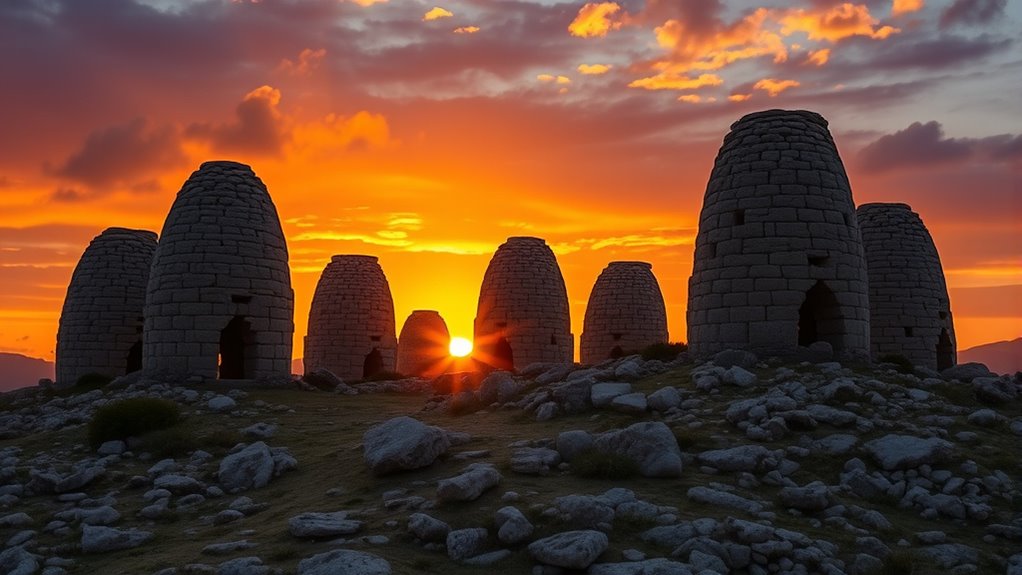

Sardinian nuragic towers evolved from simple dry-stone structures into complex, multi-chambered fortresses that showcase advanced engineering. You’ll see truncated cone shapes built with carefully laid stones, often with internal staircases and defensive features like narrow doorways and embrasures. These towers are strategically placed on hilltops or near water sources, reflecting their role in defense, community, and cultural rituals. To understand their impressive design and significance further, continue exploring their fascinating history.
Key Takeaways
- Sardinian nuragic towers are primarily constructed using dry stone methods, featuring precisely fitted large stones without mortar.
- They evolved from simple single-tower structures to complex, multi-chambered fortresses with concentric walls and defensive features.
- Architectural innovations include corbelling techniques for internal vaults, enabling taller, more durable structures.
- Key structures like Su Nuraxi di Barumini showcase multi-level design, narrow staircases, and strategic defensive elements.
- Nuragic towers often incorporate small openings, embrasures, and reinforced walls to optimize defense and resilience.
Origins and Evolution of Nuraghi
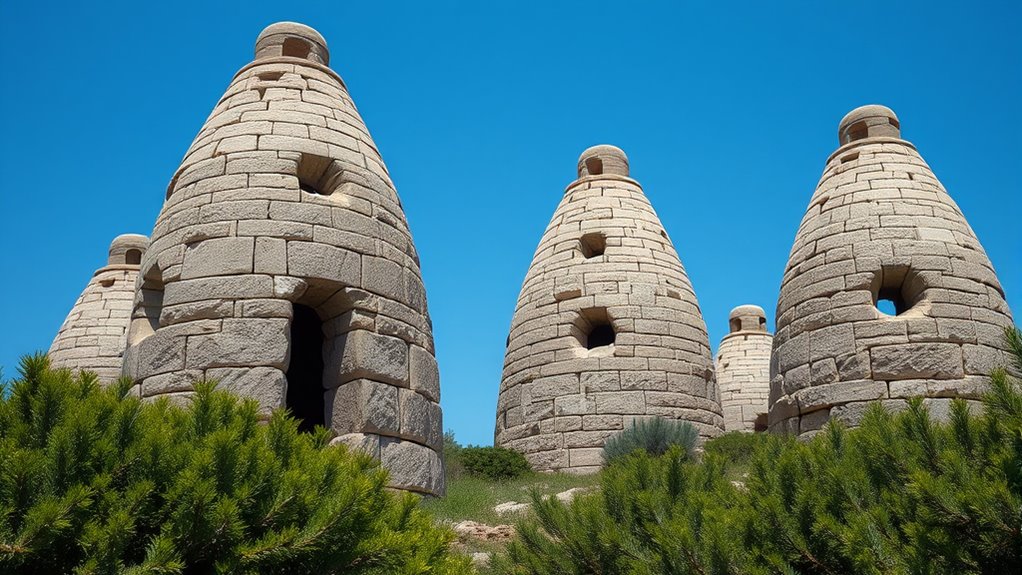
The origins of Nuragic towers trace back to the Middle to Late Bronze Age, around 1600–1200 BC, when early proto-nuraghi evolved into more complex structures. You’ll find that these initial structures were simple, single-tower forms that gradually developed into truncated cone-shaped megalithic towers with inner tholos chambers. The name “nuraghe” probably comes from a pre-Latin Sardinian word, recorded in a 1st-century AD inscription, though no written records from the culture itself exist. Early nuraghi served as defensible homesites, providing shelter, storage, and protection. Over time, these structures became more sophisticated, with some reaching multiple stories and complex arrangements, reflecting social and political growth within the community. The evolution of nuraghi signals increasing societal organization and territorial control. Additionally, approximately 10,000 nuraghi have been identified across Sardinia, indicating their widespread importance and the significance of their development in ancient Sardinian society. This extensive distribution underscores their role as a symbol of territorial identity for the Sardinian people.
Architectural Features and Construction Techniques
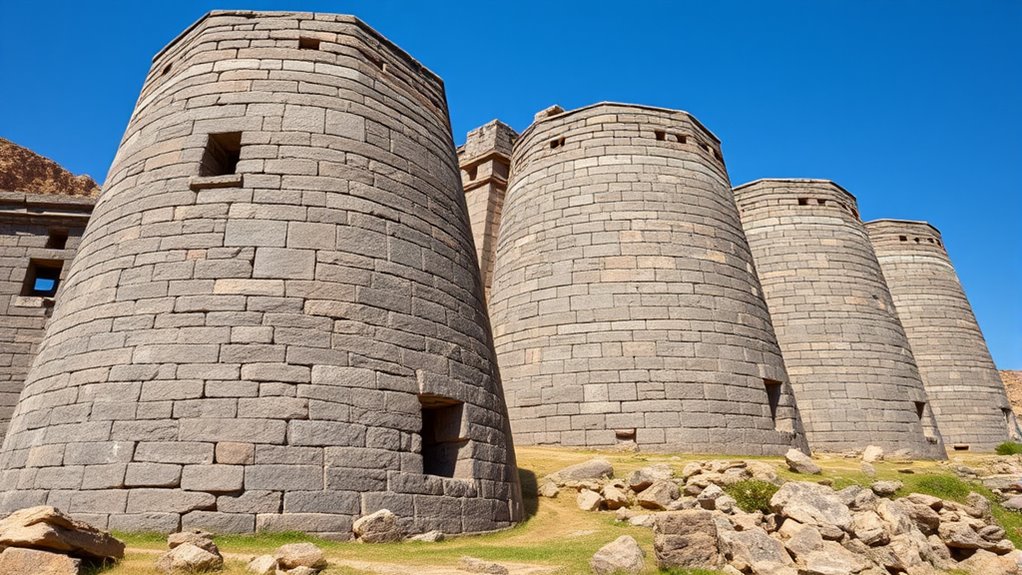
You’ll notice that Nuragic towers were built using dry stone methods, fitting large stones precisely without mortar for maximum stability. Over time, construction techniques evolved, introducing variations like finely dressed stones and innovative corbelling methods to support taller and more complex structures. These structural innovations guaranteed the towers remained stable and resilient, reflecting advanced engineering skills in prehistoric Sardinia. This evolution in construction techniques demonstrates the ingenuity and adaptability of Nuragic builders in response to architectural challenges. Additionally, the use of dry stone construction allowed for efficient resource use and ease of repair, contributing to the durability of these ancient structures.
Dry Stone Construction Methods
Dry stone construction lies at the heart of Sardinian nuraghes, relying solely on carefully selected and precisely fitted stones without mortar or binding materials. You use local rocks like granite, basalt, or limestone, choosing larger stones for the base and smaller ones upwards for balance. The main technique, dry stone corbelling, involves overlapping stones inward to create self-supporting vaults and False ceilings. Horizontal courses interlock stones for stability, and the thick, tapering walls channel weight downward, enhancing strength. The truncated cone shape, with thicker bases, reduces lateral stress, while spiral staircases and overhanging parapets showcase sophisticated dry stone craftsmanship. Construction involved leveraging primitive tools, precise stone fitting, and phased building, with modern restoration testing these ancient methods. Structural stability was achieved through meticulous stone fitting and construction techniques.
Architectural Variations Over Time
Over time, Nuragic architecture evolved from simple, single-tower structures into complex, multi-layered compounds that reflect changing social and defensive needs. Early nuraghi were mainly single, truncated conical towers with inner tholos chambers. By the Middle and Late Bronze Age, towers grew larger, with some featuring three stacked chambers. After 1300 BCE, complexes became more sophisticated, with multiple towers connected by walls and embrasures for defense. They included wider bastions and circular huts, indicating larger settlements. Larger nuraghi like Su Nuraxi di Barumini transformed into urban centers with extensions and reinforcements. Archaeological excavations have revealed that these structures often served both military and community purposes, demonstrating their multifunctional role in Nuragic society. Additionally, the construction techniques employed in their building reveal advanced knowledge of engineering and material use for their time.
Structural Innovations and Stability
Sardinian Nuragic towers showcase innovative construction techniques that guarantee their stability and durability despite the absence of mortar. They use dry stone construction with large, carefully shaped stones—mainly basalt and granite—arranged in horizontal courses or stacked with smaller stones at the top for added stability. The shapes, often truncated cones or beehives, support internal corbelled vaults that form overlapping chambers without arches. These chambers can reach 12 meters in height, with entrances featuring niches that may have structural or defensive functions. Multi-tower complexes connect with curtain walls, distributing forces and enhancing stability. Internal spiral staircases, embedded within thick walls, facilitate access while maintaining structural integrity. The corbelled vaults and precise stone placement exemplify how innovation guaranteed resilience without mortar, creating enduring, stable structures. Extreme weather conditions may test these techniques, but their design demonstrates remarkable resilience under various environmental stresses.
Strategic Placement and Distribution Across Sardinia
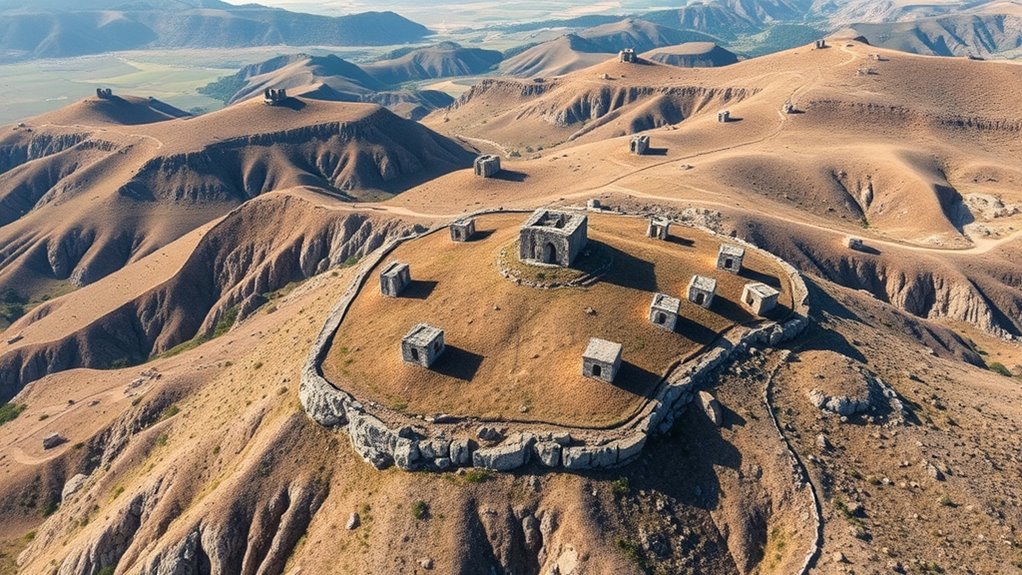
The placement and distribution of nuraghes across Sardinia reveal a strategic approach rooted in geography and resource control. You’ll notice high concentrations in the middle west, southwest, and eastern coasts, with roughly one nuraghe every three square kilometers. Nuraghes are often built on hilltops or elevated areas, maximizing visibility and defense. They’re strategically located near water sources, such as holy wells about 5 km away, and avoid heavily cultivated zones. Clusters of nuraghes form complex settlements or fortifications, supporting social cohesion and defense. Some nuraghes serve as watchtowers or territorial markers, while regional variations show denser populations in the west. Overall, their distribution reflects a careful balance between territorial control, resource management, and defensive needs. The strategic placement also highlights the importance of geographical advantages in ensuring the nuraghes’ effectiveness for communication and surveillance.
Functions and Cultural Significance

Nuraghi served not only as defensive structures but also as symbols of social status and community identity. Their size and complexity reflect their importance in cultural and social life, influencing how the Nuragic people organized themselves. You can see these towers as multifunctional sites that combined protection, religious practices, and social hierarchy in Sardinia. The construction of larger and more elaborate Nuraghi indicates their role in demonstrating the power and prestige of local leaders. Additionally, the architectural complexity of Nuraghi offers insights into the technological capabilities and societal organization of their builders.
Defensive and Residential Roles
Nuragic towers served dual purposes, functioning both as formidable defensive structures and as symbols of social organization. They were built to withstand attacks with massive walls of carefully laid stones, narrow stairways, small doorways, and minimal windows—features that limited entry and reduced vulnerabilities. Some towers appeared almost impenetrable, resembling solid rock. Internal staircases allowed defenders to move between floors while remaining protected. You’ll find that they also served residential or refuge roles, with some scholars suggesting seasonal habitation during raids. Nearby villages indicate that people lived externally but could seek shelter inside when threatened. Additionally, water features supported short-term habitation, and multi-level rooms housed extended families or groups, reinforcing their role in both defense and temporary residence. Community cohesion was often strengthened through these structures, as they also functioned as centers for community gatherings and social ceremonies, further emphasizing their importance beyond mere military use.
Cultural and Social Significance
Nuraghes hold profound religious and ritual significance, often situated near prehistoric spiritual sites like domus de Janas, menhirs, and dolmens, which form sacred landscapes. You’ll find sacred wells and Giants’ tombs close to nuraghes, highlighting their role in ceremonial practices. Many likely served as temples or cultic centers, where worship and gatherings took place. Archaeological finds such as offerings, ceramics, and symbolic artifacts support this ritual use. Some nuraghes align with celestial events, indicating an observational purpose tied to religious calendars. Beyond spirituality, nuraghes symbolize territorial power and social hierarchy, reflecting leadership and communal identity. Their widespread presence and architectural features reinforce their importance as cultural symbols, connecting Sardinian communities to their ancient roots and collective heritage. Additionally, understanding the vibrational significance of these sites offers deeper insight into their role in fostering community cohesion and spiritual resonance.
Development of Architectural Innovation

The development of architectural innovation in Sardinian towers reflects a remarkable progression from simple dry stone structures to sophisticated, multi-chambered fortresses. You see this evolution in how early proto-nuraghi with flat internal vaults transitioned into taller, multi-chambered towers with False vaults by the Middle Bronze Age. As techniques advanced, builders employed precise stone cutting, corbelling, and cyclopean masonry to increase durability and size. You can observe innovative features like spiral staircases, roofed corridors, and overlapping chambers that optimize space and defense. These innovations allowed for complex layouts, integrating ritual, residential, and defensive functions. Overall, Sardinian nuraghi showcase a continuous refinement of construction methods and architectural ideas, reflecting both technological progress and societal complexity. Additionally, the incorporation of advanced techniques such as corbelling and cyclopean masonry demonstrates an evolving understanding of structural stability and durability.
Notable Nuraghi and Archaeological Discoveries

Among the most remarkable examples of Sardinian architecture are the prominent nuraghi that stand as lasting symbols of the island’s prehistoric ingenuity. Su Nuraxi di Barumini is the most iconic, recognized as a UNESCO World Heritage site, showcasing Sardinia’s social and political complexity during the Bronze Age. Nuraghe Arrubiu in Orroli ranks among the largest, featuring multiple concentric walls and extensive chambers, exemplifying advanced engineering. Nuraghe Santu Antine in Torralba, with its polylobed design and astronomical alignments, highlights architectural sophistication. The site of Tiscali offers rare insight into late Nuragic society through a hidden village within a limestone cave. Meanwhile, Nuraghe Santa Barbara and Nuraghe Iloi reflect typical defensive structures, illustrating the diverse uses and strategic importance of Nuragic buildings across Sardinia. Archaeological discoveries at Tiscali reveal an innovative adaptation to the challenging environment, emphasizing the resourcefulness of Nuragic people in constructing their settlements.
Preservation and Heritage of Nuragic Structures

Preservation efforts for Sardinian Nuragic structures are essential for safeguarding their cultural significance and ensuring future generations can appreciate their ingenuity. You should support legal protections like UNESCO World Heritage status, which highlights their global importance. Many sites are remote, helping protect them from urbanization but making maintenance more challenging. Local communities actively participate in conservation, archaeological projects, and educational events, fostering a strong sense of stewardship. To preserve these structures, you need to contemplate:
Protect Sardinian Nuragic sites through legal status, community involvement, and preservation techniques to safeguard their cultural legacy.
- Using site-specific conservation methods based on stone type and condition
- Balancing excavation, stabilization, and access to prevent deterioration
- Ensuring restoration respects original techniques and materials to maintain authenticity
Ongoing research and technological advancements continue to improve preservation strategies, enabling more effective safeguarding of these ancient monuments.
Frequently Asked Questions
How Did Nuraghi Influence Later Mediterranean Architecture?
You see that architectural influence extends across the Mediterranean, shaping defensive strategies and monumental designs. Nuraghi’s dry-stone construction, beehive shapes, and multi-towered layouts inspired later structures like tholos tombs, citadels, and coastal forts. Their strategic placement, multifunctional use, and durable design influenced subsequent cultures, including Greeks and Romans. These towers also introduced a distinctive silhouette, enriching the region’s architectural vocabulary and symbolizing social cohesion, power, and defense for centuries.
What Symbolic Meanings Are Associated With Nuragic Tower Designs?
You might wonder what secrets lie behind nuragic tower designs. These structures aren’t just fortresses—they symbolize light, guiding signals, and celestial connections. Their strategic placement hints at visibility and spiritual ties, while their thick walls and complex layouts reveal power and protection. Circular shapes and high vantage points suggest cosmic harmony and observation of celestial cycles. Every element whispers stories of divine communication, ancestral worship, and social dominance woven into their very form.
Are There Any Oral Traditions Linked to Nuragic Structures?
You should know that many oral traditions are linked to Nuragic structures. These stories often portray the sites as magical or sacred spaces inhabited by mythic beings like fairies and witches. You’ll hear legends explaining their origins through supernatural tales, which help communities remember and honor their ancient heritage. These oral traditions embed cultural values, connecting present generations with their ancestors, and often depict the structures as more than just stone, but as symbols of protection and mystery.
How Were Nuraghi Constructed Without Advanced Tools or Machinery?
You wonder how nuraghi got built without advanced tools or machinery. You should know that builders used simple tools like stone chisels and levers, relying on precise stone placement and manual labor. They employed basic mechanical principles, such as counterweights and ramps, to lift and position heavy stones. Skilled craftsmen carefully crafted each piece, and community teamwork guaranteed the towers’ stability, demonstrating impressive ingenuity with available materials.
What Role Did Nuraghi Play in Sardinian Social Hierarchy?
Think of nuraghi as the crowns atop Sardinian society’s palace. They stood as symbols of power, marking the social hierarchy from humble beginnings to elite dominance. You’d see larger, more complex nuraghi representing influential leaders and their extended households. Located strategically, they controlled land and reinforced social status. These towers weren’t just buildings—they embodied authority, serving as centers where social, military, and spiritual roles intertwined to shape community life.
Conclusion
You now see how Sardinian nuragic towers, built over 3,000 years ago, showcase incredible architectural innovation and cultural importance. Did you know there are over 7,000 nuraghi scattered across Sardinia? This vast number highlights their significance in ancient society. Preserving these structures isn’t just about history; it’s about understanding a civilization’s ingenuity that still captivates archaeologists today. Their enduring mystery keeps Sardinia’s heritage alive and fascinating for generations to come.