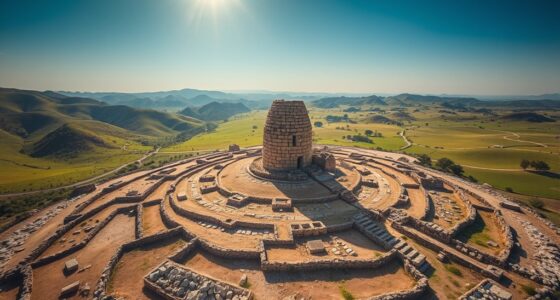
The architecture of the Nuraghe showcases Sardinia’s Bronze Age ingenuity through its impressive megalithic towers built with carefully fitted stones, often without mortar. These structures feature thick walls, rising in conical or truncated shapes that have withstood centuries of weather and seismic activity. Their layered, defensive designs reveal advanced stone fitting techniques and strong craftsmanship. If you keep exploring, you’ll uncover more about how these ancient towers symbolize resilience and cultural significance.
Key Takeaways
- Nuraghe feature unique conical or truncated cone shapes built from precisely fitted stones without mortar.
- Their thick, layered walls (up to 3 meters) enhance structural resilience against weather and seismic activity.
- Construction involved advanced stone-fitting techniques, demonstrating Bronze Age technological skills.
- Central towers or keeps are often surrounded by lower galleries or courts, creating layered defenses.
- The durable architecture reflects cultural significance, serving defensive, social, and religious functions for ancient Sardinian communities.
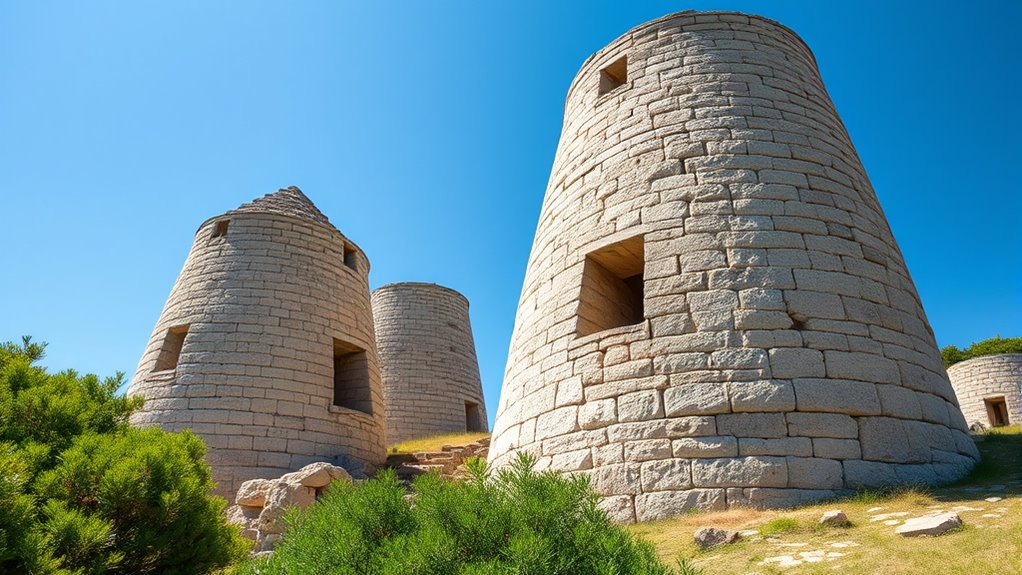
What makes the architecture of the Nuraghe so fascinating is its unique design, which has stood the testament of time. These ancient Sardinian towers date back to the Bronze Age, a period roughly between 1800 and 800 BCE, making them some of the earliest monumental structures built in the region. Their construction reflects a remarkable mastery of stone construction techniques, showcasing how Bronze Age communities could create enduring monuments without modern tools or technology. You’ll notice that each Nuraghe is built using large, carefully fitted stones, carefully chipped and placed to create a stable, durable structure that has endured centuries of weather and seismic activity.
Nuraghe architecture showcases Bronze Age mastery with carefully fitted stones enduring centuries of weather and seismic challenges.
The core of a Nuraghe is typically made from massive stones, piled without mortar but with such precision that they form a tight, stable fit. This method of stone construction was highly advanced for its time and necessary given the limited tools available during the Bronze Age. You’ll see how the stones are arranged in a circular pattern, often culminating in a conical or truncated cone shape that rises above the landscape. This design isn’t just aesthetic; it served practical purposes, providing stability and strength. The walls are often thick, sometimes up to 3 meters, which adds to their resilience. You might notice that the structures often feature a central tower or keep, surrounded by one or more lower galleries or courts, creating a complex, layered defensive system.
The Bronze Age context is essential to understanding these structures. During this period, societies in Sardinia were evolving, and the Nuraghe served multiple functions—defense, social gathering points, and possibly religious sites. Their stone construction reflects not only the technological skills of these ancient builders but also their cultural importance. You can imagine how, despite the lack of modern tools, they managed to quarry, transport, and assemble these enormous stones with precision. The fact that many Nuraghe remain largely intact today speaks volumes about the craftsmanship and significance these structures held for their creators. Additionally, the discovery of artifacts within Nuraghe sites provides valuable insight into their cultural significance and the social organization of Bronze Age Sardinia.
In essence, the architecture of the Nuraghe embodies a blend of ingenuity and resilience, rooted in the Bronze Age’s technological limits but driven by a desire to create lasting symbols of community and protection. Their stone construction is a testament to the skill and vision of those ancient people, showing that even thousands of years ago, humans could build structures that truly stood the test of time.
Thames & Kosmos Imhotep: A New Dynasty (Expansion Pack) for Award Winning Family Board Game by Kosmos | 2-4 Players | Ages 10+, Bronze
1024 playing variations when combined with base game
As an affiliate, we earn on qualifying purchases.
As an affiliate, we earn on qualifying purchases.
Frequently Asked Questions
How Did Nuraghe Builders Transport Large Stones?
You might wonder how nuraghe builders managed stone transport for their impressive structures. They used simple yet effective construction techniques, like rolling large stones on logs or dragging them with ropes and manpower. These methods allowed them to move massive stones across distances, showcasing ingenuity in stone transport. Their resourcefulness highlights their understanding of construction techniques, enabling the creation of these ancient towers despite limited technology.
What Was the Nuraghe’s Primary Purpose?
You might find that the Nuraghe’s primary purpose was more than just defense; it symbolized power and community identity, reflecting Nuraghe symbolism. Construction techniques reveal how builders used large stones to create durable structures. These towers served as strategic strongholds, social centers, or ceremonial sites, demonstrating their multifaceted role in ancient Sardinia. Their design and purpose highlight the ingenuity and cultural significance of Nuraghe builders.
Were Nuraghes Used for Residential or Ceremonial Functions?
Think of nuraghes as the heartbeat of ancient Sardinia. You’ll find they served more than just residential needs; they were sacred spaces for religious rituals and communal gatherings. These towers weren’t merely homes but symbols of unity and spiritual life. As you explore, you’ll see their purpose woven into the island’s history, acting as gathering places for ceremonies and collective celebrations, strengthening the community’s bond through shared spiritual experiences.
How Many Nuraghes Still Exist Today?
Today, you can find around 7,000 nuraghes still standing across Sardinia, showcasing impressive nuraghe preservation efforts. These ancient structures attract modern nuraghe tourism, drawing visitors enthusiastic to explore Sardinia’s rich history. You’ll notice many nuraghes are well-preserved or restored, allowing you to imagine their original purpose. This ongoing preservation helps keep Sardinia’s cultural heritage alive, making it a must-visit destination for history enthusiasts and travelers alike.
Are There Regional Differences in Nuraghe Architecture?
You’ll notice regional variations in nuraghe architecture across Sardinia, reflecting local materials and cultural influences. Some areas feature massive, well-preserved towers, while others showcase more complex, multi-tower structures that highlight architectural diversity. These differences reveal how communities adapted their construction techniques over time and geography. Exploring these regional variations gives you a deeper understanding of Sardinia’s rich ancient heritage and the ingenuity behind these iconic stone structures.

Anatomy Replica Model, Atherosclerosis Human Body Artery Model Bright Colors Simulation Ecofriendly PVC for Educational Tool
Simulation: Artery model is designed and produced through real human anatomy atlas, which enables students to understand the…
As an affiliate, we earn on qualifying purchases.
As an affiliate, we earn on qualifying purchases.
Conclusion
So, next time you marvel at modern skyscrapers, remember the Nuraghe — those ancient Sardinian towers that somehow managed to stand tall without all the bells and whistles. Who knew that simple stones and clever design could create such enduring marvels? Maybe it’s time to ditch the high-tech for a bit of good old-fashioned ingenuity. After all, if these ancient builders could pull it off, perhaps we’re overcomplicating things today!

JOINPAYA Archaeological Excavation Tools for Kids: 3 Sets Dinosaur Fossil Digging Kits with Mini Hammer Chisel Brush Scraper and Magnifier Science Kits for Dino Eggs and Gem Dig
Portable and Easy to Store: The compact size of each tool makes this dig tool set portable.Each lightweight…
As an affiliate, we earn on qualifying purchases.
As an affiliate, we earn on qualifying purchases.
ancient stone fitting techniques book
As an affiliate, we earn on qualifying purchases.
As an affiliate, we earn on qualifying purchases.