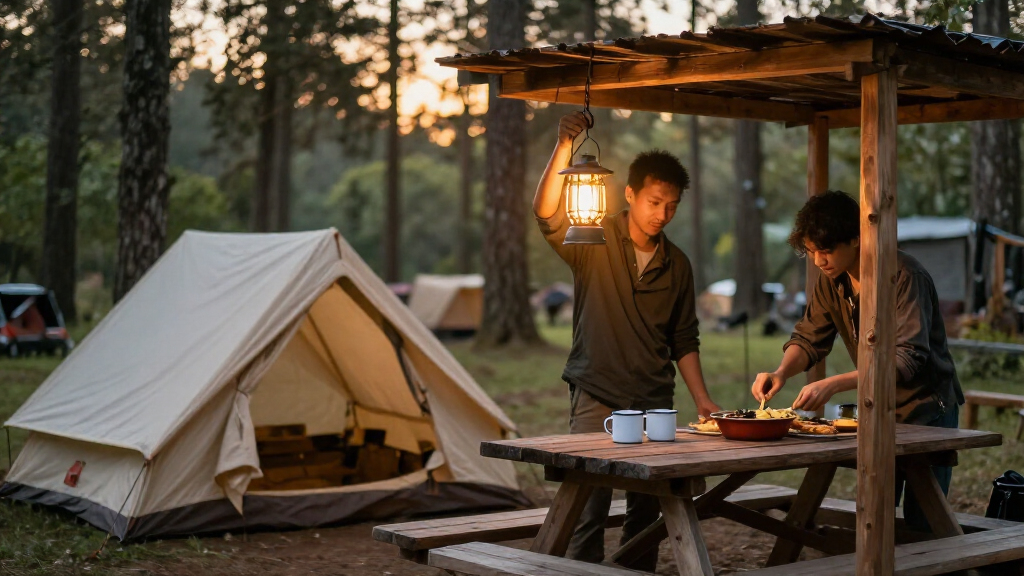
For most campers, I’d start with the Energizer S-500 Hybrid Solar Camping Lantern as the best overall option, since a hybrid charging approach is more flexible when sunlight is limited. The Glocusent 400H stands out for campers who want long-lasting rechargeable lighting, while the LuminAID Nova favors a compact, inflatable design. The main tradeoff is that solar charging can reduce reliance on outlets but is slower and less predictable than USB charging, while brighter lanterns may be bulkier or need more frequent recharging. I compare all 13 options by their power choices, campsite practicality, and specific-use strengths below. Read on for the full breakdown and a guide to choosing the right lantern for your trips.

Get travel and outdoor gear delivered free with Prime
- Fast, free delivery on millions of items
- Prime Video, Amazon Music and more included
- Member-only deals all year
Complete the kit


Key Takeaways
- Hybrid charging is the most practical advantage: the Energizer S-500 can suit trips where weather or campsite shade makes solar-only charging unreliable.
- Solar charging is a backup plan, not a guaranteed refill: models with USB charging offer a useful fallback when daylight is short or weak.
- Brightness claims do not tell the whole story: a high lumen figure may help light a shared campsite, but beam spread, dimming, and runtime matter for comfortable tent use.
- Portability has different forms: the inflatable LuminAID Nova packs flat, while the XTAUTO four-pack favors distributing smaller lights around camp.
- Extra functions bring tradeoffs: the lantern with a fan and phone charger offers more utility, but campers seeking simple, dependable light may prefer a dedicated lantern.
| Glocusent Rechargeable LED Camping Lantern, 5000mAh |  | Best for Long Runtime and Flexible Light | Maximum output: 1,500 lumens | Battery: 5,000mAh | Runtime: Up to 200 hours on low; up to 12 hours at maximum brightness | VIEW LATEST PRICE | See Our Full Breakdown |
| Energizer S-500 Hybrid Solar Camping Lantern |  | Best for Backup Charging Flexibility | Maximum output: 500 lumens | Power sources: Rechargeable lithium-ion battery or 3 AA batteries | Charging methods: Solar panel or USB | VIEW LATEST PRICE | See Our Full Breakdown |
| SAMUUN Rechargeable Solar Camping Lantern, 5000mAh, 2000 Lumens, IP65 |  | Best Overall Solar-Powered Lantern | Maximum output: 2,000 lumens | Battery: 5,000mAh lithium-ion polymer | Runtime: Over 9 hours at maximum brightness; up to 96 hours in eco mode | VIEW LATEST PRICE | See Our Full Breakdown |
| Stansport SMD LED Solar Lantern |  | Best for Simple Solar-Only Use | Brightness: 600 lumens | Power source: Solar | Runtime: Up to 2 hours on high; up to 5 hours on low | VIEW LATEST PRICE | See Our Full Breakdown |
| Rechargeable Solar Camping Lantern with 5000mAh Battery |  | Best for Lightweight, Color-Selectable Lighting | Maximum output: 2,000 lumens | Battery: 5,000mAh | Runtime: Over 9 hours at 2,000 lumens; over 85 hours in eco mode | VIEW LATEST PRICE | See Our Full Breakdown |
| SyouHome Rechargeable Solar Camping Lantern, 4000 Lumens, 6600 mAh, 2-Pack |  | Best for High-Output Group Camps | Maximum light output: Up to 4,000 lumens | Battery capacity: 6,600 mAh | Runtime: Up to 80 hours | VIEW LATEST PRICE | See Our Full Breakdown |
| Westinghouse 1000-Lumen Solar Camping Lantern |  | Best for Straightforward Emergency Lighting | Maximum light output: 1,000 lumens | Color temperature: 5,000 K | Lighting modes: High, medium, low, and SOS | VIEW LATEST PRICE | See Our Full Breakdown |
| Glocusent 400H Rechargeable Camping Lantern with Solar Charging |  | Best for Long Runtime and Compact Carry | Brightness: 15–250 lumens in description; product information lists a maximum of 1,200 lumens | Battery capacity: 5,000 mAh | Battery life: Up to 120 hours | VIEW LATEST PRICE | See Our Full Breakdown |
| LuminAID Nova Inflatable Solar LED Lantern |  | Best Compact Solar-First Lantern | Maximum light output: 75 lumens | Battery life: Up to 24 hours | Recharge options: Solar or micro USB | VIEW LATEST PRICE | See Our Full Breakdown |
| SZJIEIFR Solar Camping Lantern with Fan and Phone Charger |  | Best for Warm, Dry Campsites | Light source: LED | Illumination: 360 degrees | Power sources: Solar and battery powered | VIEW LATEST PRICE | See Our Full Breakdown |
| XTAUTO 4-Pack Collapsible Solar and USB Rechargeable LED Camping Lanterns |  | Best Value Multi-Pack | Pack size: 4 lanterns | Light source: 7 LEDs per lantern | Battery capacity: 1,600 mAh per lantern | VIEW LATEST PRICE | See Our Full Breakdown |
| Nova Ridge Rechargeable Solar Camping Lanterns, 2-Pack |  | Best for Warm, Adjustable Camp Lighting | Pack size: 2 lanterns | Charging: Solar or USB-C | Charging time: 10 hours solar; 5 hours USB-C | VIEW LATEST PRICE | See Our Full Breakdown |
| BRIMMEL Solar Outdoor Lantern Table Lamp |  | Best for High-Output Camp and Patio Use | Model: VR2001 | Charging: Solar and USB-C | Battery: 4,800 mAh lithium-ion | VIEW LATEST PRICE | See Our Full Breakdown |
| solar powered camping lantern | Water resistance | Weight | Charging |
|---|---|---|---|
| Glocusent Rechargeable LED Cam | IP45 | 299 g | USB-C; 3.5-hour charging time |
| Energizer S-500 Hybrid Solar C | IPX4 | 0.47 kg | — |
| SAMUUN Rechargeable Solar Camp | — | 250g | USB and solar |
| Stansport SMD LED Solar Lanter | Not water resistant | 1.9 pounds | — |
| Rechargeable Solar Camping Lan | — | 250g | USB and solar |
| SyouHome Rechargeable Solar Ca | IP65 | — | Solar and USB-C |
| Westinghouse 1000-Lumen Solar | IPX4 | — | Solar and USB-C |
| Glocusent 400H Rechargeable Ca | — | 153 g | USB-C and auxiliary solar |
| LuminAID Nova Inflatable Solar | IP67 | 5.3 oz | — |
| SZJIEIFR Solar Camping Lantern | Not water resistant | 13.6 oz | — |
| XTAUTO 4-Pack Collapsible Sola | Waterproof | — | Solar and USB |
| Nova Ridge Rechargeable Solar | Waterproof | 7.76 oz | Solar or USB-C |
| BRIMMEL Solar Outdoor Lantern | Waterproof | — | Solar and USB-C |
More Details on Our Top Picks
Glocusent Rechargeable LED Camping Lantern, 5000mAh
The Glocusent is a strong choice when you want a lantern for both camp use and outages, with five brightness levels and three color temperatures for tailoring light to a tent, table, or late-night task. Its stated up to 200-hour low-mode runtime is the longest listed here, though maximum output draws the battery down much faster: the 1,500-lumen mode lasts up to 12 hours, and its super-bright boost is described as lasting only four minutes. Unlike the Energizer S-500, it has no solar charging, so you need USB-C access to recharge it. In return, it offers phone charging, an SOS strobe, and a compact hanging design. Its IP45 rating handles splashes, but is less protective than the IP65 SAMUUN options.
Pros:- Up to 200 hours of stated runtime on low
- Five brightness settings and three color temperatures suit different camp tasks
- SOS strobe and USB phone-charging function add emergency utility
- Compact body includes both a top handle and bottom hook
Cons:- No solar charging; recharging depends on USB-C
- The 1,500-lumen mode is limited to up to 12 hours, while the extra-bright boost lasts only four minutes
- IP45 protection is below the IP65 rating of the SAMUUN lanterns
Best for: Campers who can recharge by USB-C and want adaptable light plus a long low-mode runtime for multi-night trips or backup use
Not ideal for: Buyers relying on sunlight as their main charging source, or campers who need stronger water and dust protection than IP45
- Maximum output:1,500 lumens
- Battery:5,000mAh
- Runtime:Up to 200 hours on low; up to 12 hours at maximum brightness
- Light settings:5 brightness levels; 3000K, 4500K, and 6001K color temperatures
- Beam angle:360 degrees
- Water resistance:IP45
- Weight:299 g
- Charging:USB-C; 3.5-hour charging time
Our verdict“Choose the Glocusent if long low-mode runtime and adjustable light matter more than solar recharging or a higher water-resistance rating.”
Energizer S-500 Hybrid Solar Camping Lantern
The Energizer S-500 earns its place for campers who value multiple ways to keep a lantern running. It can use three AA batteries or a rechargeable lithium-ion battery, with the rechargeable cell taking power from either solar or USB. That gives it a practical fallback the Glocusent Rechargeable LED Lantern lacks when USB charging is unavailable. Its 500 lumens and three modes are less versatile than the brighter SAMUUN C30 models, but should suit basic campsite lighting without chasing maximum output. The collapsible body is easy to pack, while IPX4 protection and a one-meter drop rating offer some weather and impact tolerance. The tradeoff is that the stated 500-lumen output depends on the rechargeable battery; disposable AA use still requires carrying three cells, and solar charging speed is not specified.
Pros:- Supports solar and USB charging for its rechargeable battery
- Can also run on three AA batteries when rechargeable power is unavailable
- Collapsible design includes a carry handle and hanging hook
- IPX4 water resistance and stated one-meter drop resistance
Cons:- Maximum output is 500 lumens, well below the 2,000-lumen SAMUUN options
- The stated 500-lumen output requires the rechargeable battery
- Solar charging rate and runtime figures are not provided
Best for: Car campers and preparedness-minded buyers who want solar and USB charging with AA batteries as a backup power option
Not ideal for: Campers needing high-output task lighting, documented long runtimes, or detailed information about how quickly solar charging replenishes the battery
- Maximum output:500 lumens
- Power sources:Rechargeable lithium-ion battery or 3 AA batteries
- Charging methods:Solar panel or USB
- Light modes:High, Low, and Night Light
- Beam angle:360 degrees
- Water resistance:IPX4
- Drop resistance:Up to 1 meter
- Weight:0.47 kg
Our verdict“Pick the S-500 if power-source flexibility matters more than maximum brightness or a clearly stated runtime.”
SAMUUN Rechargeable Solar Camping Lantern, 5000mAh, 2000 Lumens, IP65
The SAMUUN C30 is the best-balanced fit here for buyers specifically seeking a solar-powered camping lantern: it combines USB charging with solar replenishment, up to 2,000 lumens, and an IP65 water-and-dust rating. Its white, warm, natural, and red settings plus SOS strobe give it more range than the simpler Energizer S-500, while its 250g weight keeps it easy to pack. The stated runtime reaches up to 96 hours in eco mode, but drops to over nine hours at maximum brightness. Solar is best treated as a supplement, not a quick refill: the description says it replenishes only about 20% of the battery per day. That limitation matters on short trips with little sun, though the USB option and phone-charging feature add useful backup flexibility.
Pros:- Up to 2,000 lumens with five dimming levels and several light colors
- IP65 water and dust resistance plus stated 1.5-meter drop resistance
- Up to 96 hours of runtime in eco mode
- Lightweight at 250g, with SOS and emergency phone-charging functions
Cons:- Solar charging replenishes only about 20% of the battery per day according to the description
- Maximum-brightness runtime is over nine hours, much shorter than eco-mode runtime
- Like the Glocusent, it requires USB charging when solar replenishment is insufficient
Best for: Backpackers and campsite users who want high output, strong weather protection, and solar as a supplementary way to extend USB-charged battery life
Not ideal for: Campers expecting sunlight alone to rapidly refill the battery, or buyers who need a verified full-brightness runtime beyond the stated nine hours
- Maximum output:2,000 lumens
- Battery:5,000mAh lithium-ion polymer
- Runtime:Over 9 hours at maximum brightness; up to 96 hours in eco mode
- Charging:USB and solar
- Light modes:White, warm, natural, red, and SOS strobe
- Dimming:5 levels
- Protection:IP65 water and dust resistance; 1.5m drop resistance
- Weight:250g
Our verdict“Choose the SAMUUN C30 for a capable, weather-resistant lantern when solar charging is useful as a backup rather than your sole power plan.”
Stansport SMD LED Solar Lantern
The Stansport takes a straightforward approach: it runs on solar power and adds a USB output for charging small electronics. Its 600-lumen output exceeds the Energizer S-500’s 500 lumens, but the key compromise is endurance: the Stansport is rated for only up to two hours on high or five on low. That makes it better for a short evening or occasional use than for lighting a campsite across several nights. Unlike the USB-rechargeable SAMUUN C30, there is no alternate charging method listed, so cloudy conditions or a depleted battery leave fewer options. It is also explicitly not water resistant, a significant limitation around rain, damp ground, or wet gear. I would favor it only when simple solar operation matters more than runtime and weather protection.
Pros:- Solar-powered operation avoids carrying replacement batteries
- 600-lumen output is higher than the Energizer S-500’s stated 500 lumens
- USB output can charge electronic devices
- Two brightness settings offer a lower-power option
Cons:- Runtime is limited to up to two hours on high or five hours on low
- Not water resistant, unlike the IP65 SAMUUN C30
- No USB input or other charging method is listed
Best for: Fair-weather campers and picnic users who want a basic solar lantern for short outings and value having a USB device-charging output
Not ideal for: Backpackers on multi-night trips, campers in wet climates, or anyone needing dependable lighting beyond five hours per charge
- Brightness:600 lumens
- Power source:Solar
- Runtime:Up to 2 hours on high; up to 5 hours on low
- Brightness settings:High and Low
- USB output:Yes
- Water resistance:Not water resistant
- Dimensions:4.75 x 4.75 x 9.5 inches
- Weight:1.9 pounds
Our verdict“Choose the Stansport for short, dry outings where simple solar power and USB output outweigh limited runtime and lack of water protection.”
Rechargeable Solar Camping Lantern with 5000mAh Battery
This SAMUUN C30 listing suits campers who want multiple light colors in a light package: it weighs 250g and offers white, warm, natural, and red light, plus an SOS strobe and five brightness levels. Like the other SAMUUN C30 in this roundup, it pairs USB charging with solar replenishment and carries an IP65 rating. Its stated output reaches 2,000 lumens, with over 85 hours in eco mode, but that figure varies substantially by setting; maximum brightness is listed at over nine hours. The description also says solar adds only about 20% battery capacity per day, so it should not be treated as a self-sufficient solar charger. Compared with the more simply specified Stansport SMD, this lantern offers better weather protection and more modes, but depends on a rechargeable battery and USB charging for dependable turnaround.
Pros:- Five brightness levels and white, warm, natural, and red lighting options
- IP65 water and dust resistance with stated 1.5m drop resistance
- Lightweight at 250g and includes phone-charging capability
- Up to 2,000 lumens and over 85 hours stated in eco mode
Cons:- Solar replenishes only about 20% of battery capacity per day according to the description
- Runtime varies substantially by mode, with over nine hours stated at maximum brightness
- Its listed features closely overlap with the other SAMUUN C30, making the distinction between the two unclear
Best for: Lightweight campers who want color options, an SOS mode, and a USB-rechargeable lantern with solar assistance
Not ideal for: Buyers seeking solar-only operation, predictable runtime at a chosen brightness, or a lantern with a clearly established advantage over the other SAMUUN C30 listing
- Maximum output:2,000 lumens
- Battery:5,000mAh
- Runtime:Over 9 hours at 2,000 lumens; over 85 hours in eco mode
- Charging:USB and solar
- Lighting modes:White, warm, natural, red, and SOS strobe
- Brightness levels:5
- Protection:IP65 water resistance; 1.5m drop resistance
- Weight:250g
Our verdict“Pick this SAMUUN C30 if low weight and a broad choice of light colors are priorities and you can rely on USB charging between trips.”
SyouHome Rechargeable Solar Camping Lantern, 4000 Lumens, 6600 mAh, 2-Pack
The SyouHome pair suits campers who need broad, adjustable light at more than one spot in camp. Its stated 4,000-lumen output, three color temperatures, and three brightness levels offer more flexibility than the single 5,000K setting on the Westinghouse 1000-Lumen Solar Camping Lantern. The solar and USB-C charging options also give you a way to recharge from a power source or in daylight, while the magnetic base, hook, and tripod thread support different setups. A USB output can help with emergency phone charging. The tradeoff is size and complexity compared with the collapsible LuminAID Nova: these are flat, hard-sided lights, not tiny pack-away lanterns. The stated runtime reaches 80 hours, but the data does not clarify the setting behind that figure, so I would not treat it as a guarantee at full brightness.
Pros:- Two lanterns provide light for separate areas of a campsite.
- Three color temperatures and three brightness levels allow adjustment for tasks and ambience.
- Solar and USB-C charging provide two ways to replenish the battery.
- Magnetic base, hook, tripod mount, and USB output broaden placement and emergency-use options.
Cons:- The up-to-80-hour runtime is not tied to a specific brightness setting in the supplied data.
- The flat, hard-sided design is less packable than the collapsible LuminAID Nova.
- The 4,000-lumen maximum may be more output than some tent or close-range tasks need.
Best for: Campers outfitting a group site who want two versatile lanterns, multiple light tones, and USB-C charging.
Not ideal for: Ultralight backpackers or buyers who need a clearly specified full-brightness runtime; the pair is less compact than an inflatable lantern, and runtime varies by setting.
- Maximum light output:Up to 4,000 lumens
- Battery capacity:6,600 mAh
- Runtime:Up to 80 hours
- Color temperatures:Warm white, natural white, and cool white (6,000 K)
- Brightness levels:35%, 70%, and 100%
- Charging:Solar and USB-C
- Water resistance:IP65
- Mounting:Magnetic base, foldable hook, and 1/4-inch threaded hole
- Pack size:2 lanterns
Our verdict“Choose the SyouHome two-pack if flexible placement and high stated output matter more than a compact form and clearly defined runtime figures.”
Westinghouse 1000-Lumen Solar Camping Lantern
The Westinghouse is the straightforward choice for campers who want a familiar lantern format with solar and USB-C charging, rather than a long list of mounting features. Its 1,000-lumen maximum is lower than the SyouHome’s stated 4,000 lumens, but that makes the Westinghouse a more focused pick for tent lighting and general camp use instead of lighting a larger group area. The SOS mode adds an emergency signal option, and the integrated handle makes it easy to carry or hang. Its 5,000K daylight-white output is less adaptable than the three color temperatures on the SyouHome or Glocusent 400H. The key limitation is IPX4 water resistance: it is suited to splashes and light rain, not the stronger water protection listed for several alternatives. Choose it for simple controls, not wet-weather exposure.
Pros:- Solar and USB-C charging give campers two charging options.
- SOS mode adds a distinct emergency signaling function.
- Integrated handle supports carrying and hanging.
- Up to 1,000 lumens provides more output than the 75-lumen LuminAID Nova.
Cons:- IPX4 protection is limited to splashes and light rain.
- The fixed 5,000K color temperature offers less flexibility than the SyouHome and Glocusent 400H.
- Its 1,000-lumen maximum is below the SyouHome’s stated output for larger-area lighting.
Best for: Car campers and emergency-kit owners who want a portable lantern with a handle, SOS mode, and solar or USB-C charging.
Not ideal for: Campers who expect sustained rain or want adjustable warm-to-cool light; its IPX4 protection is limited and it offers only 5,000K light.
- Maximum light output:1,000 lumens
- Color temperature:5,000 K
- Lighting modes:High, medium, low, and SOS
- Battery:4,000 mAh lithium-ion, included
- Charging:Solar and USB-C
- Water resistance:IPX4
- Dimensions:4.54 × 4.04 × 7.95 in
- Warranty:1-year limited
Our verdict“Pick the Westinghouse for uncomplicated camp and emergency lighting, but choose a more water-resistant model for exposed, wet conditions.”
Glocusent 400H Rechargeable Camping Lantern with Solar Charging
The Glocusent 400H is a compact pick for campers who value a long stated runtime and multiple light settings over fast solar replenishment. Its 5000mAh battery, five brightness levels, and three color temperatures make it more adjustable than the Westinghouse, while its 153-gram weight is easier to justify in a packed bag than the SyouHome two-lantern set. The red SOS mode and reverse charging add useful backup functions. Solar is available, but the stated 40-hour solar charge time makes it an auxiliary option rather than a dependable quick refill; USB-C is listed at 3.5 hours. There is also a spec inconsistency: the description gives 15–250 lumens, while product information lists a 1,200-lumen maximum. I would choose it for its compact feature set, not on the assumption that its output figures are settled.
Pros:- Lightweight 153-gram design is easier to pack than the SyouHome lanterns.
- Five brightness levels and three color temperatures let users tune the light.
- USB-C charging and reverse charging support the lantern and compatible devices.
- IPX5 water resistance and 1-meter drop protection add protection for camp use.
Cons:- The listed 40-hour solar charge time makes solar charging slow.
- Brightness specifications conflict between 15–250 lumens and a 1,200-lumen maximum.
- The up-to-120-hour runtime is not paired with a brightness setting in the supplied data.
Best for: Backpackers and compact-kit campers who want adjustable light, USB-C charging, and a long stated runtime with solar as backup.
Not ideal for: Buyers relying on quick solar charging or needing unambiguous brightness specifications; solar charging is listed at 40 hours and the lumen figures conflict.
- Brightness:15–250 lumens in description; product information lists a maximum of 1,200 lumens
- Battery capacity:5,000 mAh
- Battery life:Up to 120 hours
- Brightness levels:5
- Color temperatures:3,000 K, 4,500 K, and 6,000 K
- Charging:USB-C and auxiliary solar
- Charging times:USB-C: 3.5 hours; solar: 40 hours
- Water resistance and drop protection:IPX5; 1-meter drop protection
- Weight:153 g
Our verdict“Choose the Glocusent 400H if compact carry and adjustable light matter most, while treating solar as backup and checking the output figures before buying.”
LuminAID Nova Inflatable Solar LED Lantern
The LuminAID Nova serves a different purpose from the brighter, feature-heavy SyouHome and Westinghouse: it is a lightweight, collapsible lantern for low-impact campsite lighting and easy packing. At 5.3 ounces, it is the most compelling option here when space and weight matter more than illuminating a large area. Its maximum of 75 lumens is modest beside the Westinghouse’s 1,000 lumens, so I would treat it as tent, table, or nearby task light rather than a main camp light for a group. IP67 protection and a shatterproof, dustproof design suit rougher handling and wet conditions. Solar charging takes about 10 hours in direct sunlight, while micro USB is listed at 1–2 hours. That gives it useful charging flexibility, but solar alone calls for planning ahead.
Pros:- At 5.3 ounces, it is lighter and more collapsible than the hard-sided SyouHome and Westinghouse options.
- IP67 waterproofing, dustproofing, and shatterproof construction suit outdoor handling.
- Solar and micro USB charging provide two ways to recharge.
- Up to 24 hours of battery life supports extended low-output use.
Cons:- The 75-lumen maximum is far below the Westinghouse and SyouHome outputs.
- Solar charging takes approximately 10 hours in direct sunlight.
- Its compact inflatable form is better for close-range light than broad campsite illumination.
Best for: Backpackers, paddlers, and minimalist campers who need a light, collapsible lantern for close-range lighting.
Not ideal for: Groups needing bright area illumination or campers expecting a quick solar recharge; the output tops out at 75 lumens and direct-sun charging takes about 10 hours.
- Maximum light output:75 lumens
- Battery life:Up to 24 hours
- Recharge options:Solar or micro USB
- Recharge time:Approximately 10 hours in direct sunlight or 1–2 hours via micro USB
- Water resistance:IP67
- Weight:5.3 oz
- Dimensions:4.75 × 4.75 × 4.75 in
- Beam angle:120 degrees
Our verdict“Choose the LuminAID Nova for a lightweight, water-resistant backup or tent light, not as the main lantern for lighting a large camp.”
SZJIEIFR Solar Camping Lantern with Fan and Phone Charger
The SZJIEIFR stands apart from the other picks by combining a lantern with an adjustable fan. That makes it more of a warm-weather camp accessory than a direct substitute for the solar-rechargeable SyouHome or the compact LuminAID Nova. Its 360-degree illumination can light a small shared area, and the fan rotates up to 180 degrees to direct airflow. The foldable construction also helps with storage. However, the solar-powered description needs context: the listed power sources include solar and AAA batteries, but the specifications do not provide a solar charge time or battery capacity, and the three AAA batteries are sold separately. It is also not water resistant, unlike the IP67 LuminAID and IPX5 Glocusent. I would keep it under cover and choose it for the fan, not for dependable wet-weather solar lighting.
Pros:- Combines lantern lighting with a fan for warm-weather camps.
- 360-degree illumination suits shared, nearby campsite use.
- Fan angle adjusts up to 180 degrees.
- Foldable design supports storage and carrying.
Cons:- Not water resistant, unlike the LuminAID Nova and Glocusent 400H.
- Requires three AAA alkaline batteries, which are sold separately.
- The supplied specifications do not state solar charging time or battery capacity.
Best for: Car campers in warm, dry conditions who want a basic area light and an adjustable fan in one foldable unit.
Not ideal for: Backpackers seeking a compact rechargeable lantern or campers who need rain protection; it is not water resistant and uses separately purchased AAA batteries.
- Light source:LED
- Illumination:360 degrees
- Power sources:Solar and battery powered
- Battery type:3 AAA alkaline batteries, sold separately
- Battery life:8 hours
- Fan rotation:Up to 180 degrees
- Water resistance:Not water resistant
- Dimensions:3.9 × 3.9 × 6.9 in
- Weight:13.6 oz
Our verdict“Pick the SZJIEIFR for a fan-and-light combination at a dry campsite, but choose another model for wet-weather reliability or clearly specified solar recharging.”
XTAUTO 4-Pack Collapsible Solar and USB Rechargeable LED Camping Lanterns
The four-lantern set suits group camps and emergency kits where having several lights matters more than strong output from one lamp. Each unit collapses for storage, opens into a 360-degree lantern, and can also serve as a flashlight. Solar and USB charging give you two ways to replenish its 1,600 mAh battery, with up to 25 hours of stated runtime. Compared with the Nova Ridge two-pack, XTAUTO supplies more individual lights, while Nova Ridge offers USB-C charging, warmer dimmable light, and longer low-mode runtime per lantern. The main compromise here is control: brightness depends on how far each lantern is extended, so it may be less predictable than a conventional dimmer. Its 6000 K light is also cooler than the Nova Ridge’s warm 3000 K glow.
Pros:- Four lanterns provide separate lights for multiple tents or rooms.
- Collapsible construction packs down for storage and transport.
- Each lantern works as both a 360-degree lamp and a flashlight.
- Solar and USB charging offer more than one way to recharge.
Cons:- Brightness depends on how far the lantern is extended rather than a dedicated dimmer.
- The 1,600 mAh battery capacity is modest compared with higher-capacity lantern options.
- No maximum lumen output is provided, making brightness harder to compare.
Best for: Families, group campers, or emergency-kit planners who want several compact solar- and USB-rechargeable lights to distribute.
Not ideal for: Campers who need precise brightness control, warm ambient light, or a clearly stated high lumen output.
- Pack size:4 lanterns
- Light source:7 LEDs per lantern
- Battery capacity:1,600 mAh per lantern
- Charging:Solar and USB
- Battery life:Up to 25 hours
- Beam angle:360 degrees
- Color temperature:6000 K
- Water resistance:Waterproof
Our verdict“Choose this four-pack when distributing compact lights matters more than dimming control or a specified brightness level.”
Nova Ridge Rechargeable Solar Camping Lanterns, 2-Pack
The Nova Ridge two-pack is the more comfortable choice for tent interiors and relaxed campsite evenings, thanks to dimmable 3000 K warm light rather than the cooler output of the XTAUTO lanterns. A separate white flashlight mode adds a more focused option when moving around camp, and the 7.76-ounce body can be carried or hung by its strap. Its stated runtime reaches 40 hours on low, longer than XTAUTO’s up-to-25-hour figure, though that extended runtime depends on using the lowest setting. Solar charging takes 10 hours; USB-C takes five, so USB-C is the more practical route when time is short. At a maximum of 100 lumens, it is better for close-range ambient use than lighting a large campsite. Compared with the BRIMMEL VR2001, it gives you two lights but substantially less stated maximum output.
Pros:- Dimmable warm light supports comfortable tent and campsite use.
- Separate white flashlight mode is useful for walking or close-up tasks.
- Two lanterns offer flexible placement around camp.
- USB-C charging and a hanging strap add practical convenience.
Cons:- Maximum output is limited to 100 lumens.
- Solar charging takes 10 hours.
- The 40-hour runtime applies to low mode, not maximum brightness.
Best for: Tent campers and couples who prioritize warm, adjustable ambient light, a separate flashlight mode, and a lightweight two-light setup.
Not ideal for: Campers who need a powerful area light or expect solar charging to replenish the lantern quickly.
- Pack size:2 lanterns
- Charging:Solar or USB-C
- Charging time:10 hours solar; 5 hours USB-C
- Light modes:Dimmable warm light and white flashlight
- Maximum output:100 lumens
- Battery life:Up to 40 hours on low
- Weight:7.76 oz
- Dimensions:3 × 3 × 6 in
- Water resistance:Waterproof
Our verdict“Pick Nova Ridge for two lightweight lights with warm dimming and flashlight capability, rather than high-output campsite illumination.”
BRIMMEL Solar Outdoor Lantern Table Lamp
The BRIMMEL VR2001 is the strongest fit here when one lantern needs to do more than provide a soft glow. Its three touch-controlled settings—30, 150, and 300 lumens—give it a wider brightness range than the Nova Ridge’s 100-lumen ceiling, while its diffusing shade and 3000 K color temperature keep the light warm rather than harsh. The 4,800 mAh battery is paired with up to 50 hours on low, making the lowest setting useful for long evenings or backup lighting. USB-C and solar charging support flexible replenishment, though a full charge takes eight hours. This lamp is larger and less packable than XTAUTO’s collapsible four-pack, and its 300-lumen maximum is still aimed at nearby tasks and shared spaces rather than broad, high-intensity coverage.
Pros:- Three brightness settings range from low ambient light to 300 lumens.
- USB-C and solar charging provide two charging options.
- Up to 50 hours on low supports extended use between charges.
- Diffusing shade and warm 3000 K light suit shared spaces.
Cons:- Full charging takes eight hours.
- The 300-lumen maximum is limited for lighting larger outdoor areas.
- Its table-lamp form is less packable than XTAUTO’s collapsible lanterns.
Best for: Car campers and campsite hosts who want a warm, adjustable lantern that can serve as a table lamp at camp or at home.
Not ideal for: Backpackers seeking a compact multi-light kit, or campers who need a very high-output area light.
- Model:VR2001
- Charging:Solar and USB-C
- Battery:4,800 mAh lithium-ion
- Brightness levels:30, 150, and 300 lumens
- Runtime:Up to 50 hours on low
- Charging time:8 hours
- Color temperature:3000 K
- Dimensions:5.3 × 5.3 × 7.2 in
- Water resistance:Waterproof
Our verdict“Choose the BRIMMEL for a warm, versatile table-style lantern with more output than Nova Ridge, provided portability and high-intensity lighting are not priorities.”
How We Picked
I ranked these solar-powered camping lanterns by how well their charging options, lighting, and form factor match common camping needs. I weighed whether a lantern relies only on solar or also supports USB or other charging, how useful its stated brightness and capacity appear for campsite tasks, and whether its design is easy to pack, hang, or place. I also looked at listed durability details, such as water resistance, and whether add-ons make the lantern more versatile or introduce extra bulk and complexity.
The ranking favors useful flexibility over a single headline spec. The Energizer S-500 leads because hybrid charging can help when solar conditions are poor; the Glocusent 400H and LuminAID Nova stand out for different needs rather than trying to serve every camper. Multi-packs, high-output models, and specialty designs may make more sense for particular groups, but they rank lower as all-around choices when their format or added functions narrow their appeal. Product claims are treated as listed specifications, not as proof of real-world runtime under every condition.
| solar powered camping lantern | Water resistance | Charging |
|---|---|---|
| Glocusent Rechargeable LED Cam | IP45 | USB-C; 3.5-hour charging time |
| Energizer S-500 Hybrid Solar C | IPX4 | — |
| SAMUUN Rechargeable Solar Camp | — | USB and solar |
| Stansport SMD LED Solar Lanter | Not water resistant | — |
| Rechargeable Solar Camping Lan | — | USB and solar |
| SyouHome Rechargeable Solar Ca | IP65 | Solar and USB-C |
| Westinghouse 1000-Lumen Solar | IPX4 | Solar and USB-C |
| Glocusent 400H Rechargeable Ca | — | USB-C and auxiliary solar |
| LuminAID Nova Inflatable Solar | IP67 | — |
| SZJIEIFR Solar Camping Lantern | Not water resistant | — |
| XTAUTO 4-Pack Collapsible Sola | Waterproof | Solar and USB |
| Nova Ridge Rechargeable Solar | Waterproof | Solar or USB-C |
| BRIMMEL Solar Outdoor Lantern | Waterproof | Solar and USB-C |
Factors to Consider When Choosing Solar Powered Camping Lanterns
I’d choose a lantern by matching its power system and light pattern to the trip, not by selecting the largest lumen number. These factors can help you avoid paying for features that do not suit your campsite routine.
Decide How Much You’ll Rely on Solar
Solar charging works best when the panel can receive sustained, direct sunlight, which may be difficult at shaded campsites or during cloudy weather. Treat it as a way to extend a lantern’s usefulness, not as a guaranteed daily recharge. If you camp for several nights or need dependable light at a set time, look for USB charging or another backup power option. A hybrid lantern can be more practical than a solar-only model even if its solar panel is not the largest. Check whether the product listing explains charging time and whether the lantern can be used while charging. Matching the power system to your usual weather and access to outlets matters more than the word “solar” on the package.
Choose Brightness for the Space You Need to Light
A lantern for reading inside a tent has a different job from one meant to illuminate a cooking area or a group campsite. High maximum output can be helpful outdoors, but it may create glare and drain the battery faster if there is no useful low setting. Look for dimming steps or multiple modes so you can use a softer light at bedtime and stronger light for chores. If the listing gives only a maximum lumen figure, avoid assuming it will stay at that level for the full runtime. Diffused light can feel more comfortable in a small tent than a narrow, intense beam. Think about where the lantern will hang or sit, since placement can change how evenly light spreads.
Compare Runtime Claims with Charging and Mode Details
Runtime is meaningful only when you know which brightness setting it refers to. A long runtime on low may be excellent for ambient tent light but insufficient for hours of bright meal preparation. Check whether the stated capacity is paired with runtime information at more than one output level, and whether the product describes how solar charging affects use. A larger battery can add weight without helping much if the lantern is commonly used on its brightest mode. For longer trips, a reliable way to recharge may matter more than extra capacity alone. If you cannot find clear runtime details, plan around the possibility of shorter use between charges.
Match the Shape and Packability to Your Campsite
Collapsible and inflatable lanterns can save space, while rigid lanterns may be simpler to set on a table or hang from a hook. A multipack makes it easier to put light near the tent, cooking area, and gear, but it also means keeping track of several units and charging them. Before choosing, check folded or packed dimensions rather than judging portability from a product photo. Consider how you will carry and store the lantern when it is wet or dusty, especially if it has a fabric or inflatable body. Hanging handles, stable bases, and accessible controls can be more useful at camp than decorative styling. Choose a format that fits your storage and setup habits.
Read Water-Resistance and Durability Claims Carefully
Camping equipment may face dew, splashes, dust, and accidental knocks, but not every lantern is built for the same exposure. An IP rating can provide a clearer indication of resistance than a vague claim of being weatherproof, though it does not make a lantern suitable for every storm or submersion. Check what the rating covers and whether ports need to be closed before exposure. A more elaborate lantern with a fan, phone charger, or moving parts may have more functions but also more components to protect and store. For frequent outdoor use, a simple design with clear protection details may be the safer choice. Keep charging ports and solar panels clean, since dirt can affect charging and operation.
Pay for Extras Only When They Solve a Real Camp Problem
Phone charging, fans, multiple light modes, and multipack formats can be useful, but each feature affects how you carry and use the lantern. A phone-charging function is best treated as emergency backup rather than a substitute for a dedicated power bank, since using it draws energy from the lantern. A fan may add comfort in warm weather but is less valuable if your trips are cool or you already carry a separate fan. For a first lantern, simple controls and a clear charging method can be more useful than a long feature list. Compare the added function with the added weight, charging needs, and potential points of failure. Spend extra only when you expect to use that feature on most trips.
Frequently Asked Questions
Can a solar camping lantern stay charged through several cloudy days?
That depends on its battery capacity, brightness setting, and whether it has a second charging method. Solar panels may collect less energy in cloudy weather or under tree cover, so a solar-only lantern can run short when you need it most. A USB-rechargeable or hybrid model gives you another way to top it up before or during a trip. For multi-day outings, conserve power with lower settings and carry a separate backup light. Do not plan around a solar recharge schedule unless the maker provides charging details suited to your conditions.
Should I choose a lantern with the highest lumen rating?
Not automatically. Maximum brightness can help with outdoor tasks, but it may be uncomfortable inside a tent and can use battery power quickly. A lantern with several useful brightness levels can adapt better to cooking, conversation, and reading. Also check whether the light is broadly diffused or directed, since those designs illuminate a space differently. If the listing gives only a peak lumen figure, treat it as one data point rather than a measure of how useful the lantern will be all evening.
Is a hybrid solar-and-USB lantern worth choosing over a solar-only model?
For many campers, yes, because it reduces dependence on sunshine and lets you charge before leaving home. Solar-only designs can still make sense for lightweight outings when the lantern is mainly a backup and there will be plenty of direct sun. The right choice depends on trip length, weather, shade, and whether you can bring a power bank or access an outlet. Check whether USB charging is included as a normal charging method or only described as an emergency feature. If reliable light matters more than avoiding cables altogether, hybrid charging is usually the safer fit.
Can I use a lantern’s phone-charging feature instead of bringing a power bank?
I would treat a lantern’s phone-charging port as a backup, not as a full replacement for a power bank. Charging a phone draws from the same stored energy the lantern needs for light, and the lantern’s battery may not be designed to recharge a phone repeatedly. Check whether the maker specifies output and capacity for device charging rather than assuming the lantern’s battery rating tells the whole story. If your phone is needed for maps or emergencies, carry a separate power source when possible. The charging feature is most useful for a small top-up when another option is unavailable.
Is a multipack a better choice than one brighter lantern for a group campsite?
A multipack can spread light across separate areas, which may be more practical than one bright lantern that leaves tents or paths dark. It also gives you some redundancy if one unit runs out of charge or gets misplaced. A single higher-output lantern may be simpler to manage and recharge, especially if the group stays in one central area. Compare the combined charging needs and storage space of the pack with how many locations you actually need to light. For a shared site with several tents, distributed lights can be useful; for a compact setup, one versatile lantern may be easier.
Conclusion
My best overall pick is the Energizer S-500 Hybrid Solar Camping Lantern for campers who want a fallback beyond sunlight. For best value, I’d look to the Stansport SMD LED Solar Lantern if a straightforward solar light suits your needs and you do not need high output or lots of extras. The best premium-style choice for campers prioritizing long-lasting rechargeable use is the Glocusent 400H, while the inflatable LuminAID Nova is a strong fit when pack-flat storage matters. For beginners, the Energizer’s hybrid approach is easier to plan around than relying on solar alone. Choose the SZJIEIFR lantern for its fan and phone-charging functions, the XTAUTO four-pack when you need lights in several spots, or a high-output option such as the SyouHome two-pack for a larger shared area. My final choice would come down to whether your priority is dependable charging, compact packing, distributed light, or added campsite functions.
Fall Picks

DJI Osmo Action 4 Essential Combo Waterproof 4K Action Camera
As an affiliate, we earn on qualifying purchases.