Carry-on-only travel has pushed a whole category of backpacks to compete for the same job: hold three to five days of clothes, a laptop, and travel essentials in one bag that fits under an airline seat or in the overhead bin. Two of the most frequently compared options in the premium compact segment are the Peak Design Travel Backpack 30L and the Aer Travel Pack 3 Small. They cost about the same, they’re built to a similar standard, and they target the same traveler — which is exactly why choosing between them is hard.

Get travel and outdoor gear delivered free with Prime
- Fast, free delivery on millions of items
- Prime Video, Amazon Music and more included
- Member-only deals all year

Eddie Bauer Stowaway Packable Backpack, 20L – Tobacco
- ✔ Capacity: 20L
- ✔ Weight: 0.6 lbs
- ✔ Material: Ripstop polyester

SKYSPER 15L/20L Foldable Hiking Backpack Lightweight Packable Travel Daypack with Chest Strap
- ✔ Capacity: 15L / 20L
- ✔ Weight: Approx. 0.75 lbs
- ✔ Material: Abrasion- and tear-resistant polyester
Ultra Lightweight Foldable Packable Hiking Daypack
- ✔ Capacity: 20L
- ✔ Weight: 2.3 ounces
- ✔ Material: Polyester with water-repellent coating
The real decision tension is not quality; both are excellent. It’s design philosophy. Peak Design built a expandable shell around a modular accessory system (packing cubes, camera cubes, tech pouches) that clips in and out, with side and rear access panels for grabbing gear without unpacking. Aer built a traditional top-load travel pack with fixed capacity, a cleaner internal layout, and a more polished carry for daily use at your destination. The Peak Design wins on flexibility and gear access; the Aer wins on simplicity, durability of the exterior, and how well it doubles as an everyday backpack. This guide compares them across the criteria that actually drive the choice — capacity, packing system, carry comfort, organization, laptop handling, durability, and destination usability — and tells you which traveler each one suits.
At a Glance
| Criteria | Peak Design Travel Backpack 30L | Aer Travel Pack 3 Small (25L) | Winner |
|---|---|---|---|
| Capacity and carry-on compliance | 30L expandable (up to 45L with Zip Expansion); fits most carry-on rules at 30L | Fixed 25L; reliably under-seat compliant on most airlines | A |
| Packing system and access | Clamshell main compartment plus side and rear access; modular cubes and camera cubes (sold separately) | Clamshell with compression straps and mesh pockets; simple and predictable | A |
| Carry comfort | Padded harness with load lifters and hip belt attachment points; good up to ~9 kg | Structured back panel, contoured straps; excellent at lighter loads | B |
| Organization | Modular: organization depends on accessories you buy | Built-in: file pocket, mesh dividers, multiple quick-access pockets | Depends |
| Laptop and tech handling | Dedicated 16-inch laptop sleeve, rear access, tech pouch ecosystem | Padded 16-inch laptop compartment, suspended, easy airport access | Tie |
| Build quality and durability | 400D recycled nylon canvas, weatherproof shell; more external straps and dividers | 1680D Cordura ballistic nylon; extremely abrasion resistant and easy to wipe clean | B |
| Versatility at destination | Transforms into camera bag or daypack with accessories; more ‘gear bag’ look | Sleek urban aesthetic; works as daily commuter bag out of the box | B |
| Price and value | ~$300 plus accessories ($40–$100+ each) | ~$300, no accessories required | B |
Eddie Bauer Stowaway Packable Backpack, 20L – Tobacco
The Eddie Bauer Stowaway earns our top spot because it’s the only pack in this lineup that feels like a real backpack rather than a compromise. Its ripstop polyester shell with the StormRepel water-repellent finish is meaningfully tougher than the plain woven fabric on the Ultra Lightweight pack, so it shrugs off gravel, airline handling, and unexpected drizzle without the fraying that plagues ultra-thin packables. When stuffed into its own pocket it shrinks to about 8.5 x 7 x 1.5 inches — not as tiny as our budget pick, but still small enough to slide into a suitcase’s side compartment.Where it pulls ahead of both competitors is carry comfort. The extended shoulder straps and an actual hip belt shift weight off your shoulders, which matters on days when you’re walking a city for six hours or summiting a short trail. The SKYSPER offers a chest strap but no hip belt, and the Ultra Lightweight has neither, so the Stowaway is the clear choice if you’ll actually wear the bag rather than just unfold it occasionally. Compared with the SKYSPER, you give up the multiple zippered pockets for a simpler layout — a fair trade for most travelers, but not for organization obsessives.The honest drawback: at 0.6 lbs it’s the heaviest of the three, and 20L still limits you to day-trip loads. If your goal is a barely-there emergency bag, the lighter pick below wins. But for the traveler who wants one packable bag that can do everything, this is the one.
Pros:
- Ripstop polyester with water-repellent StormRepel finish resists tears and drizzle
- Hip belt and extended shoulder straps make it the most comfortable for long carry
- Packs into its own pocket for easy portability
- Reinforced construction from an established outdoor brand
Cons:
- Heaviest of the three at 0.6 lbs
- Simpler organization than the SKYSPER’s multi-pocket layout
- 20L capacity caps it at day-trip use
Best for: Travelers who want a packable daypack comfortable and durable enough for all-day sightseeing, hiking, and daily use
Not ideal for: Ultra-minimalists counting every gram or anyone needing more than 20L for gear-heavy days
Bottom line: The most complete package here — durable, comfortable, and genuinely packable, which is why it sits at the top of our list.
“The most complete package here — durable, comfortable, and genuinely packable, which is why it sits at the top of our list.”
SKYSPER 15L/20L Foldable Hiking Backpack Lightweight Packable Travel Daypack with Chest Strap
The SKYSPER foldable daypack occupies a smart middle ground: it’s sturdier and better organized than the Ultra Lightweight pack, yet folds flatter and packs smaller than a traditional daypack. At roughly 0.75 lbs with abrasion-resistant polyester, SBS zippers, and reinforced stitching, it’s built to survive being pulled in and out of luggage daily — something the 2.3-ounce option simply can’t claim.Its defining strength is organization. Three zippered pockets, a hidden back pocket for valuables, and two tall side mesh pockets give it the most capable storage layout of the three. The Eddie Bauer Stowaway, by comparison, keeps things minimal, and the Ultra Lightweight pack is essentially one main space. If you’re the type who wants a water bottle, snacks, maps, and a passport each in their own place, this model makes the most sense for you.The standout feature is the chest strap with a built-in safety whistle, which stabilizes the load on walks and hikes — a real advantage over both competitors for trail use, though it still lacks the Stowaway’s hip belt for heavier loads. The tradeoff is its folded size: at 7.9 x 6.7 inches it’s bulkier than the pocketable Ultra Lightweight, so it belongs in a suitcase rather than a jacket. Thin straps also mean it’s best for leisurely hikes rather than fully loaded treks.
Pros:
- Most organized layout: three zippered pockets, hidden back pocket, two mesh side pockets
- Chest strap with safety whistle adds stability on trails
- SBS zippers and reinforced stitching for better durability
- Versatile enough for commuting, day trips, and leisure hikes
Cons:
- Bulkier when folded than the pocket-sized alternatives
- No hip belt, so heavy loads sit entirely on the shoulders
- Slightly heavier than the Eddie Bauer at around 0.75 lbs
Best for: Day hikers and travelers who want pocketed organization and a stabilizing chest strap in a packable bag
Not ideal for: Travelers who need the absolute smallest packed size or a hip belt for heavy loads
Bottom line: The best pick if pockets and trail-ready stability matter more to you than absolute minimum weight.
“The best pick if pockets and trail-ready stability matter more to you than absolute minimum weight.”
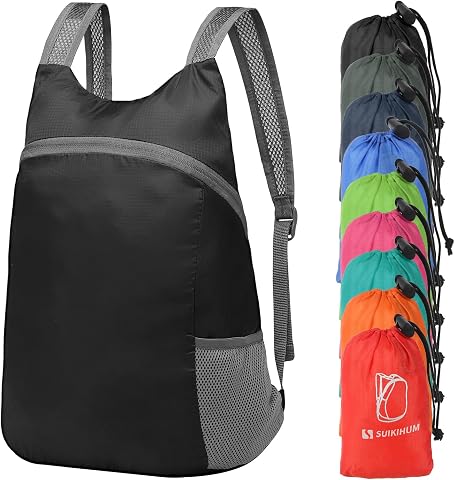
Ultra Lightweight Foldable Packable Hiking Daypack
At 2.3 ounces, this pack is in a different category from the other two — it’s less a primary backpack and more an emergency expansion chamber for your luggage. Folded down to 8.6 x 3.1 x 1 inches, it genuinely fits in a jacket pocket, a purse, or the dead space at the edge of a carry-on. Neither the Eddie Bauer Stowaway nor the SKYSPER can claim anything close to that portability, and that’s the entire reason this pick exists.The 20L capacity is surprisingly generous for something this light, and the water-repellent polyester with scratch- and tear-resistance handles light rain and rough handling better than you’d expect from the weight. The breathable mesh shoulder straps with adjustable buckles are a step above the bare webbing on many bargain packables, though they’re nowhere near as supportive as the Stowaway’s padded strap-and-hip-belt system.The tradeoff is unavoidable: the fabric that makes it featherlight won’t take sustained abuse. Compared with the SKYSPER’s reinforced stitching and the Stowaway’s ripstop weave, this pack is the one most likely to show wear after repeated hard use. There’s also minimal organization — no side mesh pockets or hidden compartments. But if your use case is occasional souvenirs, a day at the beach, or an unexpected carry-on overflow, those limitations barely matter. This model is better suited to travelers who want a backup they’ll forget they’re carrying until the day they need it.
Pros:
- Extraordinary 2.3-ounce weight — the lightest here by a wide margin
- Folds down to pocket size for true always-carry portability
- Water-repellent, scratch- and tear-resistant polyester
- Breathable mesh straps with adjustable buckles for decent comfort
Cons:
- Lightweight fabric is less durable than the ripstop or reinforced alternatives
- Almost no internal organization
- Straps lack the structure for heavy or all-day loads
Best for: Minimalists and overpackers alike who want a nearly weightless spare bag for day trips, shopping hauls, or luggage overflow
Not ideal for: Anyone seeking a primary everyday backpack or durable all-day hiking companion
Bottom line: The ultimate just-in-case pack: unbeatable packed size and weight, as long as you treat it as a spare rather than a workhorse.
“The ultimate just-in-case pack: unbeatable packed size and weight, as long as you treat it as a spare rather than a workhorse.”
As an Amazon Associate we earn from qualifying purchases.
Key Differences
The biggest structural difference is modularity versus integration. Peak Design’s Travel Backpack is a platform: its magic is in the separately sold Packing Cubes, Camera Cubes, and Tech Pouches that anchor to internal rails, letting you reconfigure the bag for a photo trip, a tech-heavy work trip, or a clothes-only weekend. The catch is that the bag is only fully useful once you’ve bought into that system, which adds real cost and complexity. Aer’s Travel Pack 3 Small has everything built in — mesh dividers, a file pocket, compression straps, a shoe compartment logic that’s simple to master in one trip. Nothing to configure, nothing extra to buy, but nothing to reconfigure either.
The second major difference is capacity philosophy. Peak Design starts at 30L and expands upward, betting you’ll sometimes need more volume. Aer fixed the Small at 25L and bet you’ll pack disciplined. For one-bag purists flying budget carriers in Europe or Asia, the Aer’s guaranteed under-seat fit is a practical advantage; for travelers who vary trip length, Peak Design’s flexibility wins. Note that at full 45L expansion, the Peak Design exceeds some airlines’ carry-on limits, so expansion is a mixed blessing.
Third is how each bag behaves at the destination. The Aer looks and carries like a high-end commuter backpack — you can wear it to a meeting or a cafe without it reading as luggage. The Peak Design, with its external straps, dividers, and system aesthetic, reads more like a gear bag and its rigidity makes it slightly less pleasant as a daily driver, though it converts into a capable camera daypack. If your trip includes a lot of urban daylight hours with the bag on your back, this difference matters more than spec sheets suggest.
Detailed Comparison
Capacity and carry-on compliance (Peak Design Travel Backpack 30L wins — moderate)
The Peak Design starts at 30L and expands to 45L via a zippered expansion collar, which is genuinely useful for variable trip lengths or souvenir acquisition. At its base 30L it fits nearly all overhead-bin carry-on rules, though at 45L expanded it will fail some airlines, especially budget European carriers. The Aer Travel Pack 3 Small is locked at 25L, which slides under most airline personal-item limits — a decisive advantage on Ryanair, Wizz Air, and similar carriers where overhead space costs extra. Peak Design wins on raw volume and flexibility; Aer wins on guaranteed compliance. For strict one-bag travelers on budget airlines, Aer’s fixed 25L is arguably the safer spec despite being smaller.
Packing system and access (Peak Design Travel Backpack 30L wins — major)
Peak Design’s clamshell opening is complemented by side and rear access panels, meaning you can pull a camera, a jacket, or a laptop from the bag without fully opening it — a real benefit in transit. Its Packing Cubes and Camera Cubes anchor to internal rails and can be lifted out whole, which changes how you pack and unpack at hotels. Aer offers a full clamshell with internal compression straps and mesh pockets — predictable, fast, and effective, but conventional. The Peak Design system is more powerful but only after you buy accessories; out of the box, the Aer is arguably better organized. If you travel with camera gear or constantly reconfigure, Peak Design is clearly ahead. For straightforward clothing-based packing, the gap is small.
Carry comfort (Aer Travel Pack 3 Small (25L) wins — minor)
Both packs are designed for loads under roughly 10 kg, and both are comfortable within that range. Aer’s Travel Pack 3 Small has a slightly more sculpted back panel and contoured shoulder straps that feel better during long urban walking days with lighter loads. Peak Design’s harness includes load-lifter straps and optional hip belt attachment, which helps when the bag is fully expanded and heavy. In practice: heavy, expanded, airport-heavy itineraries favor Peak Design; long walking days with a 7–8 kg load are a near tie with a slight edge to Aer for everyday comfort. Neither replaces a proper trekking pack, and neither should.
Organization (moderate difference)
This splits by preference. Aer builds in everything: a quick-access top pocket, a front admin-style compartment, mesh dividers in the main opening, and a dedicated file pocket. It works on day one with zero configuration. Peak Design’s built-in organization is thinner — its system assumes you’ll add cubes and pouches, and reviewers consistently note the bare bag has fewer fixed pockets. If you like deciding where everything goes yourself and don’t mind buying accessories, Peak Design’s approach is more powerful. If you want the bag to organize itself, Aer wins clearly.
Laptop and tech handling (minor difference)
Both handle a 16-inch laptop well with padded, suspended compartments and airport-friendly access — Peak Design via its rear access panel, Aer via a side-entry laptop compartment that clears security without opening the main bag. These are two of the best laptop-carrying travel packs available. Peak Design’s tech pouch ecosystem adds a small edge for people traveling with chargers, cables, adapters, and hard drives; Aer’s built-in admin pocket covers most normal needs. Call it a tie with a nudge toward Peak Design for heavy tech travelers.
Build quality and durability (Aer Travel Pack 3 Small (25L) wins — moderate)
Both are premium builds, but the materials differ in character. Aer uses 1680D Cordura ballistic nylon — extremely abrasion resistant, stiff, and easy to wipe clean; it shrugs off gate-checks, cobblestones, and overhead-bin abuse. Peak Design uses a 400D recycled nylon canvas with a weatherproof coating, which is lighter and more weather-resistant but shows wear and scuffs sooner, and its external straps and dividers create more snag points. Long-term durability reports favor Aer’s shell; Peak Design counters with a lifetime warranty. Aer wins on material toughness, moderately.
Versatility at destination (Aer Travel Pack 3 Small (25L) wins — moderate)
Once you land, the bags diverge. The Aer looks like a premium commuter backpack — black, clean-lined, appropriate in an office or a restaurant. Many owners use it as their daily bag year-round, which strengthens its value case. The Peak Design works as a daypack too, and with a Camera Cube it becomes one of the best small camera bags made — but its aesthetic is busier and its rigid frame makes it feel more like luggage on your back. If your trips involve photography or gear-intensive activities, Peak Design’s destination versatility is higher. For urban and business travel, Aer is the better second bag.
Price and value (Aer Travel Pack 3 Small (25L) wins — major)
Street prices are similar — roughly $300 for either — but the true cost differs. Peak Design’s realistic configuration (packing cubes, maybe a tech pouch or camera cube) runs $380–$450. Aer needs nothing extra. On a cost-per-use basis, Aer’s dual role as travel bag and daily commuter offsets its price quickly. Peak Design justifies its higher true cost only if you use the modular system actively; buying it ‘plain’ wastes most of what you’re paying for. Aer wins on value for most buyers.
Peak Design Travel Backpack 30L: Pros and Cons
Pros:
- Expandable 30L–45L capacity adapts to trip length
- Unmatched gear access: side, rear, and clamshell openings
- Best-in-class camera carry with Camera Cubes
- Powerful modular ecosystem for reconfiguring per trip
- Lifetime warranty
Cons:
- True cost is $380+ once you buy accessories
- Exterior scuffs and shows wear faster than ballistic nylon
- Busier aesthetic reads as ‘gear bag’ in professional settings
- At 45L expansion it exceeds some airline carry-on limits
- Fixed organization is thin without add-ons
Aer Travel Pack 3 Small (25L): Pros and Cons
Pros:
- Complete organization built in — nothing extra to buy
- Extremely tough 1680D Cordura shell that wipes clean
- Guaranteed under-seat compliance at 25L
- Doubles seamlessly as an everyday commuter bag
- Sleek, professional look
Cons:
- Fixed 25L caps you at roughly 3–4 days of clothing
- No expansion option for longer trips
- Less convenient grab-gear-in-transit access than Peak Design
- No camera-carry solution without adding your own insert
- No hip belt option for heavier loads
Who Should Choose What
Choose Peak Design Travel Backpack 30L if:
- You travel with camera gear, drones, or modular tech setups
- Your trip lengths vary and you want one bag that scales from weekend to week-long
- You value grabbing gear mid-transit without fully unpacking
- You enjoy configuring a system and will actually buy the cubes and pouches
Choose Aer Travel Pack 3 Small (25L) if:
- You fly budget carriers where under-seat personal-item compliance matters
- Your trips are clothing-focused weekends or 3–4 day business trips
- You want one bag that doubles as your daily commuter backpack
- You prefer zero-configuration organization and a clean professional look
Skip both if: You regularly travel longer than a week, carry over 10 kg, or need trekking-grade comfort — a larger 35–40L pack (like the standard Aer Travel Pack 3 or Osprey Farpoint) or a proper travel pack with a frame suits you better.
Value for Money
At face value these bags cost the same, but they don’t price the same. The Peak Design is a $300 entry ticket to a system that realistically costs $380–$450 configured, and it only delivers full value if you use the modularity — swapping cubes between trips, carrying cameras, reconfiguring for different travel modes. For that user, the extra spend is justified; no competitor matches Peak Design’s flexibility. For everyone else, paying the system premium buys features you’ll never touch.
The Aer is the stronger straightforward value: complete at $300, tough enough to last many years, and functional as a daily commuter bag, which means it replaces two purchases. Its fixed 25L is the only real limit, and if that limit fits your travel pattern, the Aer is simply more bag per dollar in daily-use terms. Paying the Peak Design premium is worth it for photographers and system-tinkerers; for clothing-centric minimalist travelers, it is not.
Final Verdict
For most people comparing these two, the Aer Travel Pack 3 Small is the better buy. It costs less in practice, survives abuse better, organizes itself out of the box, guarantees budget-airline compliance, and moonlights as your everyday backpack — which is exactly what a compact travel backpack should do. If your trips are 3–4 days, clothing-focused, and city-based, choose the Aer without hesitation.
Choose the Peak Design Travel Backpack 30L if gear defines your travel: cameras, drones, interchangeable tech loads, or trips that range from two nights to a week. Its access panels and modular cubes are genuinely better than anything Aer offers, and for photographers there is no real alternative in this size class. The deciding factor is simple: if you’ll actively use the accessory system, pay for Peak Design; if you won’t, the Aer is the smarter, tougher, cheaper-to-own choice.
Frequently Asked Questions
Can either bag fit under an airline seat as a personal item?
The Aer Travel Pack 3 Small at 25L fits under most airline seats, including strict budget carriers. The Peak Design at its base 30L usually fits under-seat dimensions but is tighter, and expanded to 45L it will not qualify on most airlines — treat expansion as overhead-bin only.
Is the Peak Design worth it without buying the accessories?
Not really. The bag’s core advantage is its modular cube system; without Packing Cubes or Camera Cubes, its built-in organization is thinner than the Aer’s and you’ve paid for capability you aren’t using. Budget for at least one or two accessories if you choose it.
Which bag is better as a daily commuter backpack between trips?
The Aer, clearly. Its 1680D shell, clean lines, and built-in laptop/admin organization make it a legitimate everyday work bag. The Peak Design can serve as a daypack but its rigid structure, straps, and gear-oriented look make it less comfortable as a permanent commuter.
How many days of clothing can each bag hold?
The Aer’s 25L suits roughly 3–4 days with packing discipline, or up to a week for ultralight packers using compression. The Peak Design at 30L handles 4–5 days comfortably, and expanded to 45L can manage a week or more — at the cost of airline compliance.
Which is better for carrying camera gear?
The Peak Design, without contest. Its Camera Cubes clip into dedicated anchors, and the side access panel lets you swap lenses without unpacking. The Aer has no camera solution beyond a generic insert you supply yourself.