
TL;DR
Solar-powered portable chargers use photovoltaic cells to convert sunlight into electricity, then either store it in a battery or send it to a device. Small built-in panels usually recharge slowly, so charge the battery from a wall outlet before a trip and treat sunlight as a useful top-up. Compare watt-hours, panel output, ports, weight, and safety guidance before buying.
Your phone can show 2% battery just as the trail loses its last cell signal. A solar charger sounds like an easy fix: leave it in the sun, then plug in. In practice, a small panel may take a long time to refill its battery, and a passing cloud can change its output.

Get travel and outdoor gear delivered free with Prime
- Fast, free delivery on millions of items
- Prime Video, Amazon Music and more included
- Member-only deals all year
Solar-powered portable chargers use photovoltaic cells to convert sunlight into electricity. Some send that power straight to a device; many store it in a built-in battery for later. This guide explains what the ratings tell you, how to choose between an integrated charger and a separate panel, and how to use either one without expecting sunlight to work like a wall outlet.
For example, if you’re camping for a weekend, you might start with a fully charged power bank and use a foldable panel to extend its runtime. That small change in expectations can make the setup far more useful.
Charge the battery from a wall outlet before a trip; use solar as a top-up.
Compare watt-hours when available because mAh does not equal usable phone energy.
Expect real panel output to vary with clouds, shade, angle, heat, and season.
Choose an integrated unit for simplicity or a separate foldable panel for more collecting area.
Check output standards, durability ratings, heat guidance, and current airline rules before travel.
Know what your solar charger actually does
A solar-powered portable charger uses photovoltaic cells to convert sunlight into electricity, then either sends that power to a device or stores it in a battery. Models with built-in storage let you charge a phone later, while panel-only models need usable sunlight when you connect a device. That distinction matters because sunlight is intermittent: stored energy separates the time you collect power from the time you need it.
Think of a panel as a small water pump: it gathers energy while conditions allow, but it cannot fill a tank instantly. A built-in battery acts like the tank. You can leave the panel collecting power during a sunny lunch stop, then charge your phone at camp after the light fades. Without storage, the phone depends on the panel’s output at that moment, so a passing cloud can slow or stop charging.
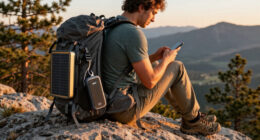
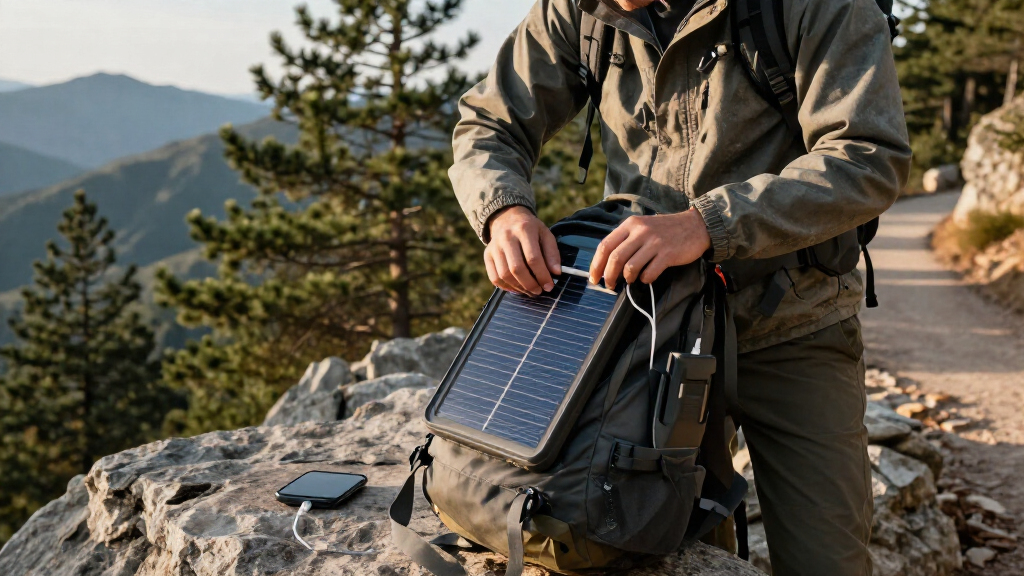
Some compact power banks include a tiny panel on one face. It can provide a trickle of energy, but its small surface area limits how quickly it can replenish the battery. That makes it useful for gradual backup, not for replacing a wall charge overnight. A larger foldable panel takes more room in your pack, yet exposes more cells to the sun and can gather more energy when conditions are good. The tradeoff is carrying and positioning extra equipment.
Check whether the product stores energy and which ports it offers. A USB-C connector alone does not promise fast charging: your device and charger must support compatible charging standards. A mismatch can mean slower charging even when the panel is producing power. Product features and availability change, so check current specifications and independent testing before buying.
Products Worth Considering

GoPro Fluid Pro AI 3-Axis Gimbal Stabilizer with AI Tracking and Fill Light

Kindle Paperwhite 16GB (2024 Model) – Graphite

DJI Osmo Action 5 Pro Essential Combo Waterproof 4K Action Camera
As an affiliate, we earn on qualifying purchases.
Read the ratings before you count on a full charge
Panel wattage and battery capacity help you compare chargers, but neither guarantees a particular charging time. A panel’s advertised wattage is a peak measured in ideal conditions; clouds, shade, panel angle, heat, and season can all lower its output. Treat the rating as a ceiling, not a promise. In practice, lower output means more time is needed to collect the same energy, and intermittent sun makes planning around a precise refill time risky.
Battery capacity often appears in milliamp-hours (mAh), but that figure does not tell you exactly how much energy reaches your phone. The mAh number describes charge at a particular voltage, and batteries and phones may operate at different voltages. Voltage conversion and charging losses reduce usable capacity. When manufacturers provide watt-hours (Wh), that number gives you a clearer energy comparison across batteries because it accounts for both charge and voltage.
Say you’re comparing two power banks for a day hike. One lists a higher mAh figure, while the other gives a Wh rating and more useful port details. The second label may help you compare more fairly, but you’ll still want to check the output your phone needs and the product’s stated capacity. A larger stored-energy number can mean more potential phone charges, but it can also mean more weight; the right balance depends on how long you’ll be away from outlets.
Here are the key points for comparing the label with your plans:
- Panel output: Look at the rated watts, then expect less under changing outdoor conditions. Lower real-world output means slower collection, so allow extra time.
- Stored energy: Compare Wh when available; don’t assume all listed mAh becomes usable phone power. More capacity offers a larger reserve but usually adds size or weight.
- Charging standard: Check the supported output and charging protocol, not just the USB-C shape. Compatibility affects how quickly power can reach your device.
- Weight and size: A larger panel may collect more power but take up more pack space. Consider whether that extra area is useful for the sunlight and time your trip actually offers.
Choose a setup that fits your trip
An integrated solar power bank is simpler to carry, while a separate panel and battery usually give you more flexibility and panel area. Choose based on whether you value a tidy, all-in-one pack or more collecting capacity. Neither setup removes the need to plan around sunlight: the practical advantage of extra panel area depends on having time and a suitable place to set it in the sun.
| Setup | What works well | Trade-off |
|---|---|---|
| Built-in panel and battery | One compact unit; convenient for short outings and backup | Small panel can recharge the battery slowly |
| Foldable panel plus power bank | More panel area; useful for longer outdoor stays | More gear to pack, position, and connect |
| Panel without storage | Can power a compatible device in suitable light | Output changes with sunlight; no stored energy for later |
For a day hike, a charged power bank with a small panel may be enough to top up a phone. For a three-day campsite with good sun, a foldable panel paired with a separate battery may be more practical because it can gather energy while you are away from outlets and save it for later. If the forecast calls for heavy cloud, carry a charged battery rather than relying on the panel alone; extra panel area cannot make up reliably for limited sunlight.
Check the power bank’s Wh rating against the airline’s current battery rules if you plan to fly. Capacity limits can affect which battery you can carry, so verify official guidance before booking. Also check product care and warranty details, especially if you expect rain, dust, or rough handling. A durability rating can help you understand the limits, but it does not mean every part of the charger is protected in every condition.
Use sunlight to extend power, not to promise it
Solar charging is slow and variable on many portable chargers, especially on compact power banks. For a predictable refill, charge the battery from a wall outlet before leaving, then use the panel to extend its runtime outdoors. That approach gives you stored energy even if the afternoon turns cloudy. It also lets you treat whatever the panel collects as extra reserve, rather than making essential navigation or communication depend on a favorable stretch of weather.
Here’s a simple routine for a weekend camping trip:
- Charge at home: Fill the power bank from mains power and test its cable and ports.
- Place the panel in open sun: Angle it toward the sun and move it when shade crosses the surface.
- Keep devices ventilated: Follow the manufacturer’s instructions; don’t bake the phone or battery on a hot rock.
- Save stored power: Charge the phone from the battery pack when you need a stable connection or when sunlight drops.
- Check progress: Confirm that the device is charging, since changing light can slow or interrupt output.
For instance, a hiker can leave a foldable panel open during a sunny lunch break and reconnect it later at camp. The power gathered may help cover navigation and messages, but it may not refill a large power bank. Shade, clouds, panel angle, and device demand all affect the result. Checking progress tells you whether the setup is contributing power; it does not guarantee that it will collect enough for every planned use.
Ordinary indoor lighting is generally too weak for useful charging, and cloudy skies produce much less power than direct sun. A solar panel is a helpful extension in favorable conditions, not a guaranteed backup supply. The more your plans depend on a device, the more important it is to carry enough stored charge before setting out.
Check the safety details before taking it outdoors
A charger’s outdoor appearance does not prove that it can handle rain, heat, or rough treatment. Check the stated water-resistance and dust rating, along with care instructions for the ports and battery pack. A rating may apply to one part of a product and not another. This distinction matters because exposed connectors or an unprotected battery can be the weak point even if the panel itself tolerates splashes.
Heat deserves special attention. The panel needs sunlight, but a lithium-ion battery and a phone can get too hot if left in direct sun with little airflow. Excess heat can stress batteries and may trigger protective shutdowns, interrupting the charging you were counting on. Follow the manufacturer’s guidance and keep devices ventilated; for example, place the panel in the sun while keeping the battery pack shaded when the design permits.
Choose a reputable product with appropriate safety protections, and stop using it if its battery looks swollen or damaged. If a campsite has children, set up cables and gear where adults can supervise them and keep the power bank away from water play. A charger does not make a pool, lake, or wet campsite safe; close supervision around water remains necessary.
Solar charging can reduce your reliance on grid power in some situations, but a small charger is not impact-free. Its materials, how often you use it, and how long it lasts all affect its environmental footprint. A durable charger that earns a regular place in your kit may serve you better than a fragile model left in a drawer, since a product used repeatedly is more likely to provide lasting value for the resources it took to make.
Make the charger earn its place in your bag
The best solar charger is the one that matches how you actually travel. A compact integrated model suits someone who wants occasional backup on short walks; a foldable panel makes more sense when you spend several sunny days away from outlets and can carry extra gear. For routine commuting, wall charging may be simpler and more reliable. The choice comes down to whether the extra weight and setup time are worth the additional power you can gather on your typical trip.
Picture a family taking a two-night cabin trip. They charge the power bank at home, use it for evening phone charging, and set the panel outside during the day to collect extra energy. If rain arrives, they still have the original battery reserve. That modest setup answers a practical need without assuming the panel will run every device.
Before you buy, match the port output to the devices you plan to charge. A compact phone model may not support a tablet or laptop, while some higher-output panels can serve larger devices when the output and device input are compatible. Check the total output, supported charging standards, weight, durability, and warranty together. These details work as a system: adequate capacity does little if a port cannot supply the device’s required output, and high output may not be worthwhile if the setup is too heavy to bring.
Specific models, prices, certifications, and availability change. Read up-to-date specifications and independent tests, and verify airline battery rules with the carrier or relevant official authority before travel. If you remember one thing, start with a charged battery and let the sun add useful extra hours.
Frequently Asked Questions
Can a solar-powered charger charge my phone?
Yes, if its output and cable match your phone. A small panel may charge slowly, and shifting sunlight can interrupt or reduce its output.
How long does it take to recharge a solar power bank?
There is no single charging time. Panel output, battery size, sunlight, shade, angle, and season all affect it, so treat manufacturer estimates as best-case figures.
Can I charge a solar charger indoors or on a cloudy day?
A panel may produce some power in diffuse light, but far less than in direct sun. Ordinary indoor lighting is generally too weak to provide useful charging.
Should I buy a built-in battery or a separate panel?
A built-in battery is simpler to carry and suits short outings or occasional backup. A separate foldable panel offers more area and flexibility, but takes extra space and needs a power bank for stored energy.
Can I leave the charger in direct sun?
The panel needs sunlight, but heat can damage or stress a lithium-ion battery and your phone. Follow the maker’s instructions, keep devices ventilated, and avoid leaving them in extreme heat.
How do I know if it is waterproof?
Check the product’s stated water-resistance rating and care instructions. Confirm whether the rating covers the ports and battery pack as well as the panel.
Conclusion
Choose a solar charger for the conditions you expect, not the perfect-sun numbers on its box. Start with a charged power bank, check that its ports suit your devices, and let the panel stretch your supply when daylight cooperates.
Then pack it where the sun can reach it and your phone can stay cool. The smartest solar setup gives you more time off the grid without asking the weather to keep a promise.