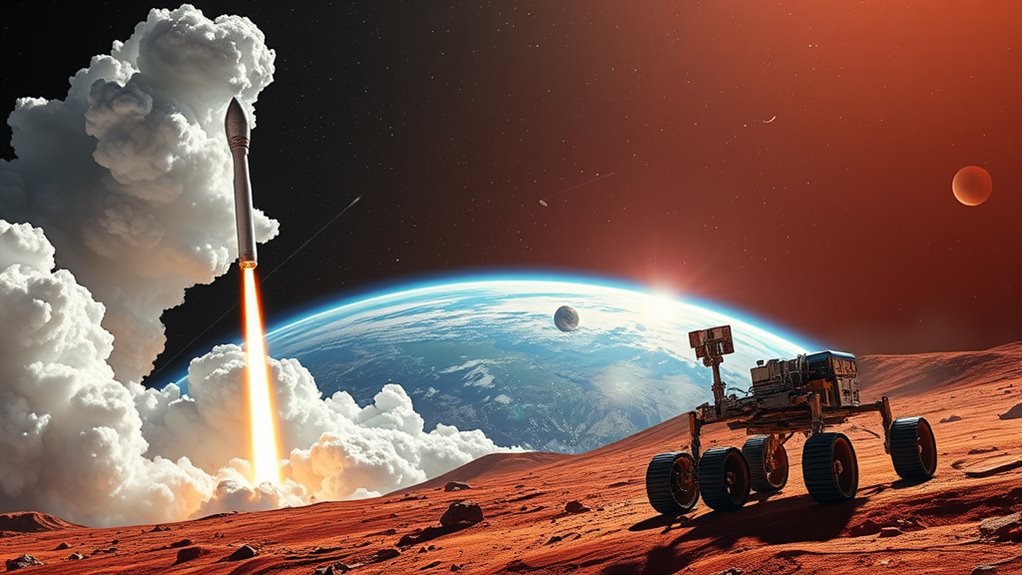

By 2025, space exploration milestones are paving the way for incredible progress. You’ll see advancements in Mars colonization plans, with agencies like NASA and private firms such as SpaceX developing propulsion and habitat tech. The Lunar Gateway continues to evolve as a key hub for lunar and deep space missions, supporting sustainable human presence. If you stay tuned, you’ll uncover how these innovations are shaping the future of interplanetary exploration and human space travel.
Key Takeaways
- Mars colonization efforts are advancing with missions focused on habitat development and resource utilization for sustainable human presence.
- The Lunar Gateway serves as a critical staging point for lunar exploration and future Mars missions, enabling long-term space operations.
- Progress in propulsion, habitat, and life support technologies is making deep space exploration more feasible and efficient.
- Robotic missions continue testing landing techniques, resource extraction, and habitat construction on the Moon and Mars.
- International collaborations and private companies like SpaceX are driving innovative missions shaping the future of human spaceflight by 2025.

Space exploration has achieved remarkable milestones that have expanded our understanding of the universe. These accomplishments not only push the boundaries of science but also pave the way for future missions that could redefine our place in the cosmos. One of the most ambitious goals on the horizon is Mars colonization, which aims to establish a sustainable human presence on the Red Planet. This endeavor involves developing advanced propulsion systems, life support technologies, and habitat modules capable of withstanding Mars’s harsh environment. You’re witnessing a new era where sending humans to Mars isn’t just a distant dream but a strategically planned mission, with agencies like NASA and private companies like SpaceX leading the charge. Their efforts focus on creating the infrastructure needed to support long-term settlement, including supply routes and communication networks. As these plans materialize, you’ll see significant progress in robotic missions that test landing techniques, resource utilization, and habitat construction, all laying the groundwork for eventual human arrival.
Simultaneously, the Lunar Gateway stands out as a critical piece of this interplanetary puzzle. This space station, orbiting the Moon, acts as a staging point for lunar exploration and future missions deeper into space. Its role is to facilitate crewed missions to the lunar surface, conduct scientific research, and serve as a refueling and maintenance hub for spacecraft heading toward Mars. You’ll notice that the Lunar Gateway symbolizes a shift from traditional lunar exploration to a sustained presence around the Moon. It’s designed to be modular, with international collaboration at its core, involving agencies and nations working together to establish a permanent lunar outpost. This station helps develop the technologies needed for long-duration spaceflight, such as life support systems, radiation shielding, and autonomous operations. You may also be interested to know that advanced propulsion systems are integral to making these missions more feasible and efficient. As it becomes operational, it will enable more complex missions, making lunar science more accessible and preparing humans for the challenges of Mars colonization.
Together, these milestones—Mars colonization efforts and the Lunar Gateway—serve as cornerstones for the next phase of space exploration. They demonstrate our collective drive to push beyond Earth’s confines, deepen our scientific knowledge, and develop the technology required for future generations. You’re witnessing a transformative period where human spaceflight is becoming more feasible, sustainable, and interconnected. The advancements made now will shape missions in 2025 and beyond, ultimately bringing us closer to becoming an interplanetary species. These milestones mark a new chapter in exploration, one that promises to discover secrets of the universe while expanding human horizons into the vastness of space.
Frequently Asked Questions
What Are the Upcoming Private Sector Collaborations in Space Missions?
You’re likely to see more private sector collaborations in space missions, driven by new commercial partnerships and innovative funding strategies. Companies like SpaceX, Blue Origin, and others are teaming up with government agencies and each other to share costs and expertise. These collaborations aim to accelerate technological advancements, reduce expenses, and expand opportunities for exploration and satellite deployment, shaping the future of space missions well into 2025 and beyond.
How Will New Technologies Impact Future Space Exploration Efforts?
New technologies like advanced space propulsion will substantially boost your space exploration efforts by enabling faster and more efficient travel to distant planets. These innovations also pave the way for building extraterrestrial habitats, making long-term missions feasible. As you adopt these cutting-edge solutions, you’ll experience reduced costs and increased safety, ultimately expanding humanity’s reach into space and unblocking new scientific discoveries and opportunities for future generations.
What Are the Long-Term Plans for Lunar Colonization?
You’re on the brink of witnessing a lunar revolution! Long-term plans focus on establishing sustainable colonies, harnessing lunar resource utilization to support life and energy needs, and advancing habitability research to create comfortable environments. These ambitious efforts aim to turn the Moon into a second home, paving the way for future space exploration. With ongoing innovations, you could see humans thriving on the lunar surface within decades.
How Does Space Exploration Address Potential Planetary Threats?
You can help address planetary threats through space exploration by supporting asteroid tracking efforts, which identify potentially hazardous objects early. These missions improve planetary defense by developing technologies to deflect or mitigate asteroid impacts. Your involvement in advocating for advanced surveillance and response systems guarantees we stay prepared, reducing risks and protecting Earth from potential catastrophic events. Active space exploration is vital for safeguarding our planet from future planetary threats.
What Roles Will Artificial Intelligence Play in Upcoming Missions?
AI integration will act as the navigator guiding your missions through uncharted territories, much like a beacon in the dark. Robotics advancements will empower your spacecraft and rovers, making them smarter and more autonomous. You’ll see AI analyze data faster than ever, predict issues before they happen, and optimize resource use. Together, these tools will turn complex tasks into manageable adventures, pushing the boundaries of what’s possible in space exploration.
Conclusion
As you look toward 2025, remember that each mission is like planting a flag on a new frontier, pushing humanity’s boundaries further. Just like the rover that once rolled across Mars, your curiosity fuels progress. These milestones aren’t just milestones—they’re stepping stones, turning dreams into reality. Keep watching the skies, because with each discovery, we’re not just exploring space; we’re charting the course for our future among the stars.