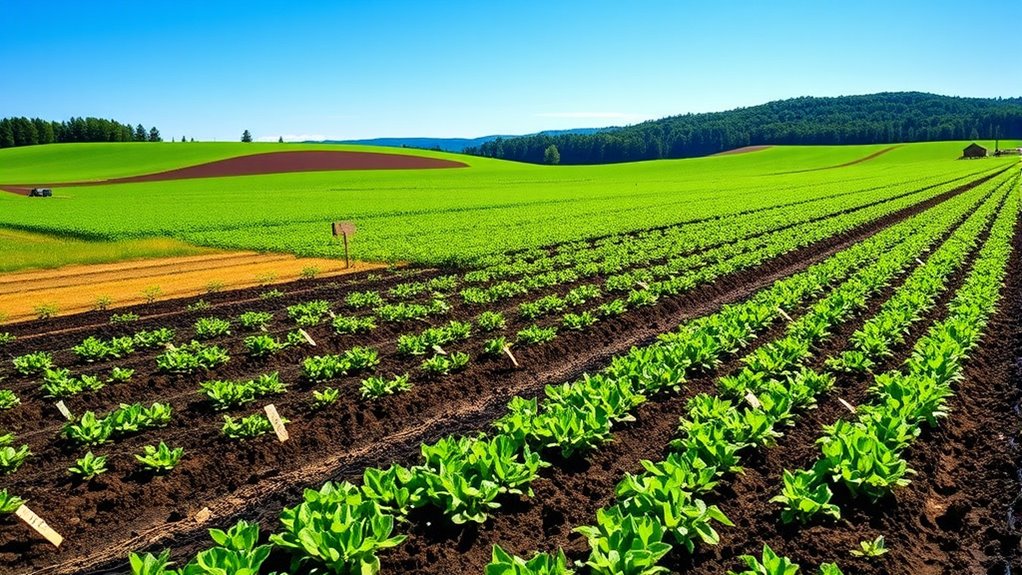

Carbon farming helps you reduce greenhouse gases by using land management practices that improve soil health and increase organic matter. Techniques like cover cropping, crop rotation, reduced tillage, and adding organic amendments trap CO₂ underground, transforming land into a carbon sink. Healthy soils are more resilient, store water better, and boost crop yields. To find out how these practices can benefit you and the environment further, keep exploring the key strategies involved.
Key Takeaways
- Carbon farming uses land management practices like cover cropping and reduced tillage to increase soil organic matter and capture atmospheric CO₂.
- Healthy soils with high organic matter act as natural carbon sinks, sequestering CO₂ underground.
- Crop rotation and cover crops enhance soil health, organic matter, and carbon storage capacity.
- Improved soil management reduces erosion, boosts crop yields, and creates potential for carbon credits.
- These practices increase climate resilience by improving water retention and adapting land to climate change.
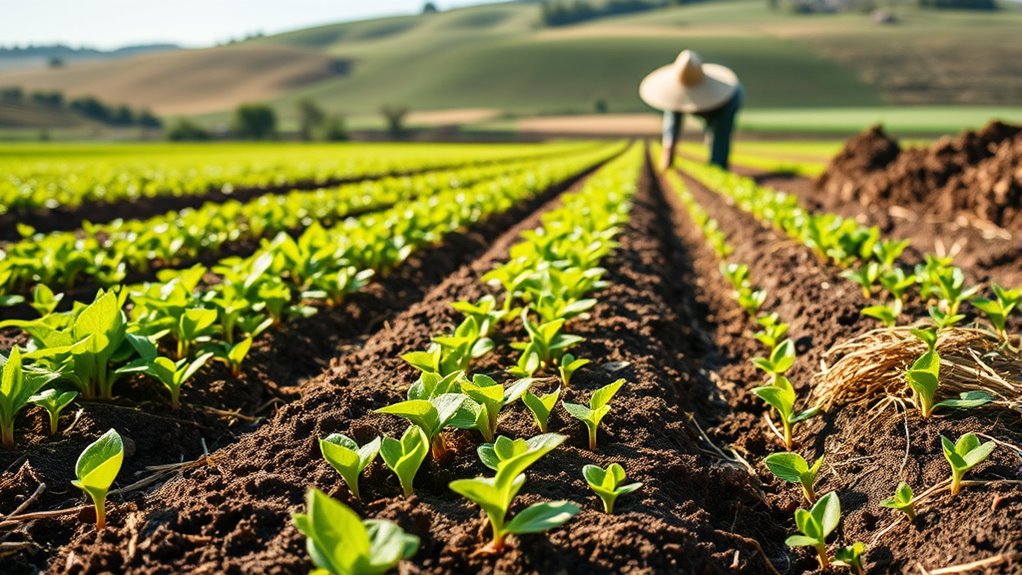
Carbon farming is an innovative approach that allows farmers to actively reduce greenhouse gases in the atmosphere by implementing specific land management practices. One of the key strategies involves improving soil health, which not only boosts productivity but also enhances the soil’s capacity to sequester carbon. Healthy soil is rich in organic matter, which acts as a natural sponge, capturing carbon dioxide from the air and storing it underground. To achieve this, you can adopt practices like reduced tillage, cover cropping, and organic amendments, all aimed at fostering a vibrant soil ecosystem. These methods increase microbial activity, improve soil structure, and promote nutrient retention, making your land more resilient and productive while simultaneously drawing down atmospheric carbon.
Healthy soil with organic matter captures and stores atmospheric carbon effectively.
Crop rotation plays a fundamental role in this process. By alternating different crops in your fields, you prevent soil degradation and break pest and disease cycles, leading to healthier, more productive soil. Different crops contribute various types of organic matter and root structures that support diverse microbial communities, which are essential for stable carbon storage. For instance, legumes fix nitrogen naturally, reducing the need for synthetic fertilizers that can emit greenhouse gases during production. When you rotate cover crops like clover or vetch, you add organic material to the soil, further increasing its carbon content. These practices create a cycle of continuous improvement; as your soil health improves through crop diversity and cover cropping, it becomes more capable of sequestering additional carbon.
Implementing crop rotation and soil health practices also benefits your farm’s overall sustainability. Healthier soils require less chemical input and are more resistant to erosion and drought. Plus, as your soil’s carbon content increases, your farm can potentially generate carbon credits, offering an additional revenue stream. You’ll notice that the more you focus on building soil organic matter through crop rotation and other regenerative practices, the more your land becomes a carbon sink rather than a source. This shift not only benefits the environment but can also improve crop yields and reduce input costs over time.
Moreover, integrating these practices into your land management plan is a proactive step toward climate resilience. As climate patterns become more unpredictable, healthy soils with high carbon content help retain water more effectively, supporting crops during dry spells. By actively managing your land through crop rotation and soil health initiatives, you’re contributing to a broader effort to combat climate change, all while improving your farm’s productivity and sustainability. Ultimately, these practices turn your farm into a powerful tool for carbon sequestration, making a meaningful impact on reducing atmospheric greenhouse gases.
In addition, understanding and utilizing forage crops can significantly boost organic matter and soil carbon storage, further enhancing your farm’s climate benefits.

MySoil Soil Test Kit, Unlock Your Lawn & Garden Potential, Complete & Accurate Nutrient and pH Analysis with Recommendations Tailored to Your Soil and Plant Needs
- Professional Soil Testing Kit: Accurately measures nutrients and pH
- Fast Results: Receive analysis in 6-8 days
- Versatile Compatibility: Suitable for all soil types and plants
As an affiliate, we earn on qualifying purchases.
As an affiliate, we earn on qualifying purchases.
Frequently Asked Questions
How Long Does It Take to See Measurable Soil Carbon Increases?
You can typically see measurable soil carbon increases within 1 to 3 years, depending on your sequestration rate and farming practices. The soil carbon timeline varies based on factors like soil type, crop rotation, and management techniques. By consistently applying regenerative practices, you accelerate sequestration, making it possible to notice improvements sooner. Keep track of your progress regularly to understand how quickly your efforts are boosting soil carbon levels.
What Are the Costs Associated With Starting Carbon Farming Practices?
You might wonder about the costs of starting carbon farming practices, and the answer isn’t straightforward. It requires a financial investment in new equipment, cover crops, or soil amendments. You also need to take into account risk management, as returns depend on factors like climate and market prices. While initial expenses can seem significant, strategic planning can help mitigate risks and make this sustainable venture more feasible over time.
Can Carbon Farming Be Combined With Traditional Crop Production?
Yes, you can combine carbon farming with traditional crop production. Incorporate crop rotation and cover cropping to improve soil health and enhance carbon sequestration. These practices don’t require major changes and can boost your yields while capturing more carbon. By integrating these techniques, you support sustainable farming, improve soil fertility, and contribute to climate change mitigation, all without sacrificing your existing crop production methods.
Are There Any Government Incentives for Adopting Carbon Farming?
Yes, government incentives are available for adopting carbon farming. You can access policy incentives and funding programs designed to encourage sustainable practices. These initiatives often include grants, tax credits, or technical assistance to help you implement soil management techniques that sequester carbon effectively. Checking with local or national agricultural agencies will help you find specific programs you qualify for, making it easier to integrate carbon farming into your operations.
How Do Soil Types Affect Carbon Sequestration Effectiveness?
You’ll find that soil types substantially influence how well you can sequester carbon. Finer soils with good soil texture hold more organic matter, making them ideal for capturing carbon. Conversely, sandy soils drain quickly and may store less organic matter, reducing sequestration potential. By understanding your soil’s texture and organic matter levels, you can tailor your practices to maximize carbon storage and improve soil health effectively.
![No-Till Cover Crop 13-Seed Mix (1 lb. Bag): [50% Clovers Plus Fenugreek, Vetch, Flax, Cowpeas, Buckwheat, Forage Peas, Millet, Lentils, Crimson Clover, Sweet Yellow, White Clover, Medium Red Clover]](https://m.media-amazon.com/images/I/61tz3UL4ZfL._SL500_.jpg)
No-Till Cover Crop 13-Seed Mix (1 lb. Bag): [50% Clovers Plus Fenugreek, Vetch, Flax, Cowpeas, Buckwheat, Forage Peas, Millet, Lentils, Crimson Clover, Sweet Yellow, White Clover, Medium Red Clover]
- Premium All-Natural Seed Mix: High-quality, Nitro-coated, USA-grown
As an affiliate, we earn on qualifying purchases.
As an affiliate, we earn on qualifying purchases.
Conclusion
So, next time you’re tempted to ignore your dirt, remember: your soil’s got a secret—it’s a carbon vault just waiting for you to unseal it. Think of yourself as a superhero, saving the planet one plow at a time, all from the comfort of your farmland. Who knew that sequestering carbon could be so heroic? So go ahead, embrace carbon farming—because saving the world has never been so dirt cheap.

Hollow Garden Hoe Small Hoe Garden Tool Carbon Steel Farm Tool for Weeding Soil Loosening and Cultivating, 8.38X5.51 Inches
- Heavy Duty Hollow Hoe: Ideal for weeding and soil loosening
- Durable Manganese Steel: Resists wear and deformation
- Ergonomic Design: Comfortable grip reduces fatigue
As an affiliate, we earn on qualifying purchases.
As an affiliate, we earn on qualifying purchases.

Farmer’s Secret Soil Revitalizer – Organic (OMRI Listed) Dirt Health Booster – Liquid Compost Soil Amendment – Activated Humic Acid (32oz)
- Soil microbial stimulation: Boosts microbial activity in soil
- Monthly application recommended: Apply monthly during growing season
- Organic, chemical-free formula: Contains OMRI-listed activated humic acids
As an affiliate, we earn on qualifying purchases.
As an affiliate, we earn on qualifying purchases.