
Structural battery composites combine energy storage and vehicle support into one component, drastically reducing weight and freeing up space. This integration can make electric vehicles lighter, more efficient, and easier to design, leading to better performance and longer ranges. It also simplifies manufacturing by eliminating separate batteries and structural parts. As this technology advances, it could transform vehicle construction in ways you haven’t imagined—continue exploring to discover the full potential of these innovative materials.
Key Takeaways
- Integrate energy storage and structural support, reducing vehicle weight and space for improved efficiency and range.
- Enable lighter vehicle designs that enhance acceleration, handling, and safety through combined material functions.
- Overcome manufacturing challenges with advanced composites and innovative fabrication techniques for reliable mass production.
- Advance material science with conductive nanomaterials and composites to balance electrical performance and mechanical strength.
- Facilitate the development of streamlined, sustainable electric vehicles with simplified architectures and lower costs.
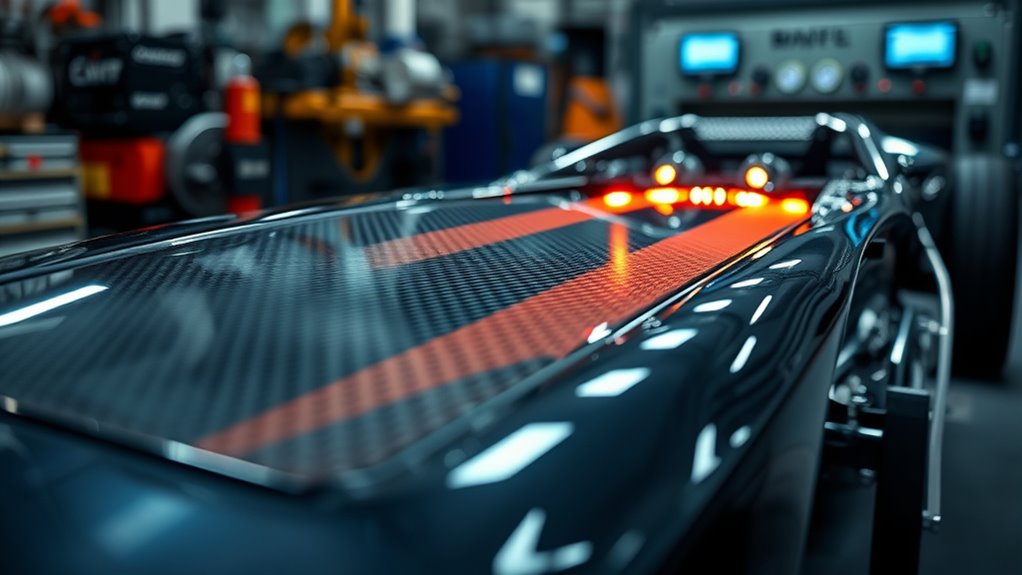
Structural battery composites are innovative materials that combine the functions of energy storage and mechanical support within a single component. This integration means you can eliminate the need for separate batteries and structural elements, leading to significant reductions in weight and space. For electric vehicles, this innovation offers the promise of lighter vehicles with greater energy efficiency and improved range. Since lightweight materials are central to this technology, your vehicle can benefit from enhanced performance without compromising safety or durability. By embedding energy storage directly into the vehicle’s body or chassis, you reduce the overall mass, which translates to better acceleration, handling, and energy consumption. Additionally, leveraging advancements in AI-powered manufacturing techniques can enhance quality control and precision during production. However, developing these composites isn’t without its hurdles. Manufacturing challenges are at the forefront, as producing materials that fulfill both structural and energy storage roles requires precise engineering and advanced fabrication techniques. Achieving the right balance between electrical conductivity, mechanical strength, and durability isn’t straightforward. These composites must withstand the rigors of vehicle operation—vibrations, temperature fluctuations, and long-term wear—without losing their functional integrity. This demands sophisticated manufacturing processes that can uniformly embed electrochemical components within composite matrices, often involving complex layering, curing, or printing techniques. Scaling these processes for mass production adds another layer of difficulty, as consistency and quality control become critical. Despite these challenges, ongoing research is making strides toward practical solutions. Material scientists are exploring new composite formulations, such as integrating conductive polymers or nanomaterials, to enhance electrical performance while maintaining structural integrity. Manufacturing innovations, like automated layering and additive manufacturing, are helping to address the complexities of producing these composites efficiently. As these challenges are progressively overcome, the impact on electric vehicle design could be transformative. You could see vehicles with integrated energy storage that are not only lighter but also more durable and easier to manufacture. In essence, the journey toward widespread adoption of structural battery composites hinges on solving manufacturing challenges related to creating reliable, scalable processes that produce lightweight materials capable of dual functions. When these hurdles are cleared, your electric vehicle will benefit from a more streamlined, efficient architecture that maximizes space, reduces weight, and boosts overall performance. This technological leap could redefine how electric vehicles are built, making them more sustainable, cost-effective, and better suited to meet future mobility demands.
Mighty Max Battery MM-G35 Start and Stop Car BCI Group Size 35 12V 55Ah, 100RC, 650 CCA Rechargeable AGM Car Battery
Fast Starting Power: This 12V 55Ah 650 CCA delivers strong, steady starts is ready for any weather in…
As an affiliate, we earn on qualifying purchases.
As an affiliate, we earn on qualifying purchases.
Frequently Asked Questions
What Is the Current Commercial Availability of Structural Battery Composites?
Coincidentally, the market adoption of structural battery composites is still in its early stages, with few products available commercially. You’ll find some prototypes and pilot projects, but widespread use remains limited due to concerns about material durability and cost. Manufacturers are actively researching to improve these composites, aiming for more durable, affordable options that can eventually transform electric vehicle design and performance.
How Do Structural Battery Composites Compare in Cost to Traditional Batteries?
You’ll find that structural battery composites generally have higher manufacturing expenses compared to traditional batteries, leading to a less favorable cost comparison now. While they offer benefits like weight reduction and design integration, the advanced materials and processes increase production costs. However, as manufacturing techniques improve and economies of scale develop, expect these cost differences to narrow, making structural composites more competitive in the future.
Are There Any Safety Concerns With Integrating Structural Batteries Into Vehicles?
Think of your vehicle as a fortress; integrating structural batteries is like adding a new layer of armor. Safety concerns include potential battery fire risks and structural integrity concerns if the materials aren’t perfectly balanced. While these composites are designed to be robust, a failure in structural integrity could lead to safety issues, so rigorous testing and standards are vital to guarantee they provide strength without compromising safety.
What Is the Environmental Impact of Manufacturing Structural Battery Composites?
You might be concerned about the environmental impact of manufacturing structural battery composites. You should know that sourcing raw materials can lead to recycling challenges, making it harder to reuse components efficiently. Additionally, extracting raw materials often involves energy-intensive processes that contribute to pollution. By addressing these issues, manufacturers can minimize environmental harm, but ongoing innovations are needed to improve sustainability and reduce the ecological footprint of producing these advanced composites.
How Long Is the Expected Lifespan of Structural Battery Composites in EVS?
You can expect structural battery composites in EVs to last about 8 to 15 years, depending on usage and maintenance. Their battery durability is designed to withstand material degradation over time, but factors like temperature fluctuations and charging cycles influence lifespan. Proper care helps maximize their longevity, ensuring your vehicle performs reliably for many years. Advances in materials continue to improve durability, making these composites increasingly resilient and long-lasting.

GoolRC 10pcs EV-Peak GA102 Battery Capacity Indicator Charge Marker Record Sticker for Rechargeable Battery
High quality, easy to use.
As an affiliate, we earn on qualifying purchases.
As an affiliate, we earn on qualifying purchases.
Conclusion
By blending brilliance with innovation, structural battery composites promise a powerful, lightweight leap forward. You’ll witness a wave of wonder as weight wanes and efficiency escalates. This breakthrough brings bold, blank slates for building better, braver batteries that bolster battery life and boost vehicle performance. As these composites carve a clear course toward cleaner, cutting-edge cars, you get to be part of a transformative trend—turning technological turbulence into triumph.

Vibrating Knife Cutting Machine – Industrial Oscillating Flatbed Cutter for Fabric, Leather and Composite Materials, High Speed CNC Knife Cutter for Garment and Automotive Manufacturing
【Fully Customizable】: We offer a variety of models and configurations to help you create a customized solution. The…
As an affiliate, we earn on qualifying purchases.
As an affiliate, we earn on qualifying purchases.

Nanomaterials for Advanced Energy and Power Storage Devices
As an affiliate, we earn on qualifying purchases.
As an affiliate, we earn on qualifying purchases.