
Metal-Organic Frameworks (MOFs) are highly tunable materials that help you capture carbon dioxide and improve cooling systems. Their porous, crystalline structures allow precise control over pore size and chemistry, making them exceptionally efficient for gas adsorption. You can customize MOFs to target specific gases or optimize heat transfer. By understanding their design options, you’ll discover how these adaptable materials can address environmental challenges and enhance industrial applications—exploring more reveals even greater potential.
Key Takeaways
- MOFs’ tunable pore structures enable selective adsorption of CO₂, making them effective for carbon capture applications.
- Their high surface area and customizable chemistry enhance gas interactions, improving cooling and pollutant removal efficiency.
- Structural modifications allow MOFs to optimize heat transfer properties for cooling technologies.
- Hierarchical pore design facilitates rapid gas diffusion, boosting performance in environmental remediation.
- Ongoing research advances MOF functionalities, supporting sustainable energy and greenhouse gas reduction strategies.
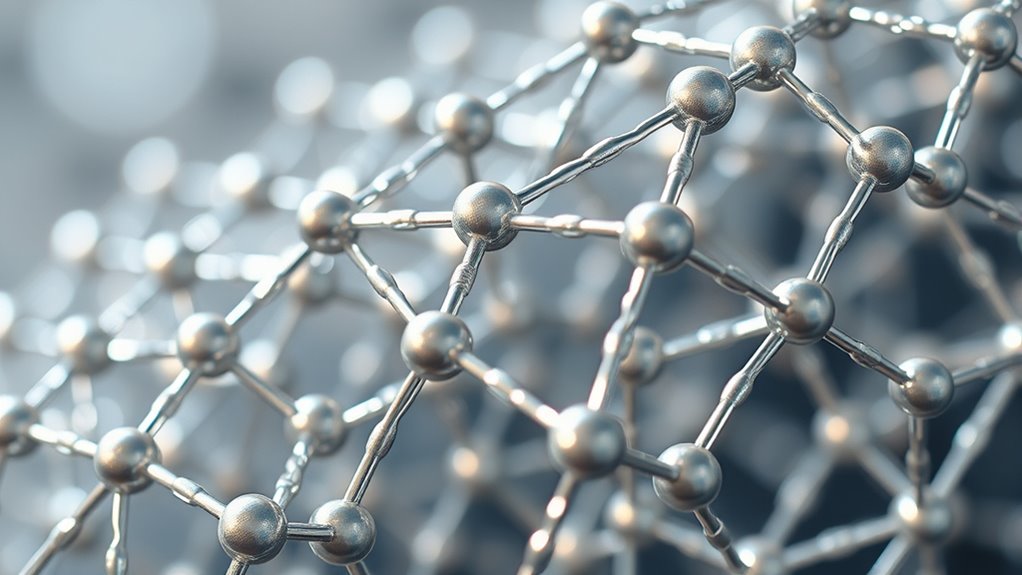
Have you ever wondered how scientists create materials with incredibly high surface areas and tunable structures? The answer lies in metal-organic frameworks, or MOFs, which are revolutionizing the way we think about capturing gases like carbon dioxide and improving cooling technologies. These materials are composed of metal nodes connected by organic linkers, forming porous, crystalline structures that can be precisely engineered. Their unique combination of high surface area and adjustable architecture makes them ideal for applications requiring selective adsorption of gases.
Metal-organic frameworks are highly tunable porous structures revolutionizing gas capture and cooling technologies.
When you explore the adsorption mechanisms within MOFs, you discover that their effectiveness hinges on how gases interact with their internal surfaces. The pores provide a large surface for molecules to cling to, and the chemical environment within those pores can be tailored to favor specific gases. For example, by modifying the organic linkers, you can enhance the affinity for carbon dioxide, making it easier to trap and separate from other gases. This selectivity is key to reducing greenhouse gas emissions and improving carbon capture technologies. The adsorption process can involve physical interactions, like van der Waals forces, or more complex chemical bonds, depending on the design of the MOF. This flexibility ensures that you can customize MOFs for different environmental and industrial needs.
Structural tunability is another critical aspect that makes MOFs stand out. You have the power to adjust their pore size, shape, and chemical functionality by selecting different metals and organic linkers. This means you can optimize the material for specific gases or thermal properties. For carbon capture, you might choose linkers that create a pore environment highly receptive to CO₂ molecules. For cooling applications, you can engineer the structure to maximize heat transfer or moisture adsorption. Such versatility allows you to develop materials tailored for particular conditions, whether it’s capturing pollutants from industrial flue gases or controlling humidity in climate systems.
The process of tuning these structures isn’t just about trial and error; it’s grounded in understanding how different configurations influence adsorption performance. You can design MOFs with hierarchical pores for rapid gas diffusion or with functional groups that strengthen adsorption bonds. This level of control means you’re not limited to a one-size-fits-all solution — you can create bespoke materials that meet specific environmental challenges. As research progresses, the ability to manipulate both the adsorption mechanisms and structural tunability of MOFs will continue to open new possibilities for sustainable energy, pollution reduction, and advanced cooling technologies. Advances in material science are essential for unlocking the full potential of MOFs in these fields.
Top picks for "metal organic framework"
Open Amazon search results for this keyword.
As an affiliate, we earn on qualifying purchases.
Frequently Asked Questions
How Are MOFS Synthesized at an Industrial Scale?
You can synthesize MOFs at an industrial scale through scalable synthesis methods like solvothermal, rapid mixing, or continuous flow processes. These techniques allow for large quantities while maintaining quality, making them suitable for industrial applications. By optimizing reaction conditions and using cost-effective raw materials, you guarantee efficient production, enabling MOFs to meet the demands of carbon capture, cooling, and other industrial uses effectively and sustainably.
What Are the Environmental Impacts of MOF Production?
You should consider that MOF production impacts the environment through its environmental footprint and resource consumption. Manufacturing processes often require significant energy and raw materials, leading to greenhouse gas emissions and waste generation. While some efforts aim to make production more sustainable, you need to be mindful of minimizing resource use and reducing pollution to lessen these environmental impacts and promote eco-friendly development of MOFs.
Can MOFS Be Integrated Into Existing Carbon Capture Systems?
You can absolutely integrate MOFs into existing carbon capture systems, but it’s not straightforward. Modular integration is key; you need to guarantee system compatibility to avoid disruptions. Some systems may require adjustments, while others can seamlessly incorporate MOFs. The potential is huge—think enhanced efficiency and adaptability—but it’s vital to carefully evaluate your current setup to open these benefits without compromising performance.
How Do MOFS Perform Under Long-Term Operational Conditions?
You’ll find that MOFs generally perform well under long-term operational conditions, showcasing good stability and durability. They maintain their adsorption capacity over extended periods when properly engineered and protected from moisture or other degrading factors. While ongoing research aims to improve long-term stability, current MOFs demonstrate solid operational durability, making them promising for continuous carbon capture applications. Regular maintenance can help guarantee ideal performance over time.
Are MOFS Cost-Effective Compared to Traditional Materials?
You’ll find that MOFs can be cost-effective compared to traditional materials, especially when considering their high efficiency and potential for regeneration. Their economic feasibility improves as production methods advance and scale up, reducing costs. Plus, their material durability under operational conditions means you won’t need frequent replacements, saving money long-term. While initial costs may be higher, their performance and longevity often make MOFs a smart, cost-efficient choice for carbon capture and cooling applications.
Conclusion
You might think metal-organic frameworks are just promising materials for carbon capture and cooling, but their true potential lies in how they challenge our assumptions about efficiency and sustainability. By exploring their capabilities, you realize that innovation often starts with questioning what’s possible. Embracing this mindset can lead you to see that the future depends on pushing boundaries and rethinking solutions, proving that sometimes, the most groundbreaking ideas come from daring to believe in the impossible.