
Use this guide to select a suitable turkey roasting pan with a lid, prepare the bird, roast it, and confirm it has reached a safe temperature. It is written for home cooks with basic kitchen skills. Allow 3-5 hours for roasting and resting; thawing time is additional.

Get travel and outdoor gear delivered free with Prime
- Fast, free delivery on millions of items
- Prime Video, Amazon Music and more included
- Member-only deals all year

22-Inch Stainless Steel Roasting Pan with Lid and Rack
- ✔ Material: Stainless steel
- ✔ Shape: Oval
- ✔ Dimensions: 22 × 13 × 10.8 inches

JY COOKMENT 21-Inch Rectangular Roasting Pan with Lid, V-Rack, and Turkey Baster
- ✔ Material: Alloy steel
- ✔ Finish: Painted porcelain
- ✔ Shape: Rectangular

18-inch Enamel Carbon Steel Turkey Roasting Pan with Lid
- ✔ Material: Carbon steel with enamel finish
- ✔ Shape: Oval
- ✔ Dimensions: 18 × 12.8 inches; interior 15 × 11 inches
Difficulty: Beginner | Time: 3-5 hours, depending on turkey size
What You’ll Need
Tools & Materials:
- Oven-safe roasting pan with a lid, large enough to hold the turkey without touching the sides
- Instant-read or probe food thermometer
- Kitchen scale or turkey package label showing the bird’s weight
- Cutting board and carving knife
- Paper towels and oven mitts
Knowledge:
- Basic oven use
- How to read a food thermometer
Thaw a frozen turkey in the refrigerator before roasting, allowing about 24 hours for every 4-5 pounds (1.8-2.3 kg). Keep raw turkey refrigerated and wash hands and surfaces after handling it. Check the pan and lid instructions for oven temperature limits; do not use a lid with plastic parts unless the manufacturer rates it for oven use.
22-Inch Stainless Steel Roasting Pan with Lid and Rack
For cooks who routinely prepare a large turkey, the QPMR’s stated 26-pound capacity gives it the broadest headroom in this lineup. Its elevated rack is intended to promote heat circulation around the bird, while the lid offers a covered-roasting option. Compared with the JY COOKMENT, it is an inch longer and lists a slightly greater capacity; unlike that set, it does not include a baster or a lid described as a second roasting pot.The polished stainless steel interior and riveted handles point to a straightforward, durable-feeling setup, and the pan is listed as dishwasher safe. The tradeoff is scale: at 22 × 13 × 10.8 inches, it may be awkward to fit in an oven or store between holiday meals. Its 470°F maximum is also the lowest listed temperature limit among these three options, so buyers should check that it suits their recipes. We rank it first for the large-bird use case, not for kitchens short on space.
Pros:
- Stated 26-pound capacity is the largest of the three.
- Includes a lid and elevated roasting rack.
- Riveted handles and polished stainless steel interior.
- Dishwasher-safe construction.
Cons:
- Large dimensions may be difficult to fit and store.
- 470°F maximum is the lowest listed temperature limit in this roundup.
Best for: Households roasting large turkeys that have enough oven and cabinet space for a 22-inch pan.
Not ideal for: Cooks with compact ovens or limited storage, or those seeking the highest listed temperature limit or a multipurpose lid.
Bottom line: Choose the QPMR when large-bird capacity and an included rack matter more than compact storage or extra accessories.
“Choose the QPMR when large-bird capacity and an included rack matter more than compact storage or extra accessories.”
JY COOKMENT 21-Inch Rectangular Roasting Pan with Lid, V-Rack, and Turkey Baster
The JY COOKMENT stands out for what comes with it: a V-shaped rack, a turkey baster, and a lid that can also be used as an open roasting pot. That extra flexibility makes it a more complete setup than the QPMR, whose listed components are limited to the pan, lid, and rack. Its stated 25-pound capacity is close to the QPMR’s 26 pounds, so it can still suit a substantial bird without claiming the top capacity in this group.This model is rectangular, measuring 21.2 × 14 × 9 inches; the wider shape may suit some oven layouts and cooking plans, but it still needs considerable room. It is listed as dishwasher safe and has a painted porcelain finish over alloy steel. The supplied temperature limit is 600°C, notably higher than the other listed limits, though buyers should follow the manufacturer’s care and use instructions. Compared with the smaller Granite bowl pan, this is the better-equipped choice for a full holiday spread, but its size and accessory emphasis may be unnecessary for occasional small-bird roasting.
Pros:
- Stated capacity accommodates a turkey up to 25 pounds.
- Includes a V-rack and turkey baster.
- Lid can also be used as an open roasting pot.
- Dishwasher safe.
Cons:
- 21-inch rectangular dimensions require substantial oven and storage room.
- Alloy steel with a painted porcelain finish may require attention to care instructions.
Best for: Cooks who want a large turkey pan with a rack, baster, and a lid that can serve another cooking role.
Not ideal for: People with limited oven space or anyone seeking the shortest pan in this comparison.
Bottom line: Pick the JY COOKMENT for the most versatile included setup, provided its broad rectangular footprint fits your kitchen.
“Pick the JY COOKMENT for the most versatile included setup, provided its broad rectangular footprint fits your kitchen.”
18-inch Enamel Carbon Steel Turkey Roasting Pan with Lid
At 18 inches long, this oval pan is the most compact option here, and its stated capacity of up to 16 pounds makes its intended scale clear. For a smaller turkey or other roast, the enamel-coated carbon steel design offers a covered pan without the footprint of the QPMR or JY COOKMENT. The enamel finish is described as supporting even heat distribution and moisture retention; those are useful aims for covered roasting, though the capacity is the key limit for buyers planning a larger bird.Its listed maximum of 932°F is well above the other products’ stated limits. The pan is also dishwasher safe and listed as free from PFOA and PTFE, but the coating can be damaged by overly hard cleaning tools. Its compatibility restrictions deserve particular attention: the product details exclude induction cookers, glass ovens, and microwaves. Compared with the two larger steel pans, this is easier to justify when compact dimensions matter, but it is a poor match for a big gathering or a kitchen relying on one of those excluded appliances.
Pros:
- Shortest listed length at 18 inches.
- Enamel coating is described as supporting even heat distribution and moisture retention.
- Listed maximum temperature is 932°F.
- Dishwasher safe and listed as free from PFOA and PTFE.
Cons:
- Capacity is limited to up to 16 pounds, below the two larger pans.
- Not compatible with induction cookers, glass ovens, or microwaves.
- Enamel can be damaged by overly hard cleaning tools.
Best for: Cooks preparing turkeys up to 16 pounds who want an oval, lidded pan with a smaller listed footprint.
Not ideal for: Anyone roasting a bird over 16 pounds, using a glass oven or induction cooker, or needing a pan for microwave use.
Bottom line: Choose this enamel pan for a smaller bird and compact storage, after confirming its appliance restrictions fit your kitchen.
“Choose this enamel pan for a smaller bird and compact storage, after confirming its appliance restrictions fit your kitchen.”
As an Amazon Associate we earn from qualifying purchases.
Before You Start
Check that the pan fits in your oven with the lid on and that you can lift it safely when hot. A heavy covered pan can be difficult to maneuver, especially when filled. Set a rack low enough to leave clearance for the lid. Remove the turkey neck and giblets from the cavities, and do not rinse the bird, since splashing can spread raw poultry juices.
Roasting times are estimates. The turkey is ready only when a thermometer confirms the required temperature. If the bird is stuffed, the center of the stuffing must also reach 165°F (74°C); cooking stuffing separately is easier to check and usually cooks more evenly.
Step-by-Step Instructions
Step 1: Choose a pan that fits
Measure the inside of the roasting pan and compare it with the turkey’s dimensions, including the height under the lid. Choose a sturdy pan that leaves room for air and heat to circulate around the bird. Confirm that the lid, handles, and any rack are oven-safe at your planned roasting temperature.
Tip: A tight fit can make the turkey hard to remove and may keep heat from circulating well. Use a larger pan or a smaller bird if the lid presses against the turkey.
Check: The turkey sits on the rack without touching the lid or sides, and the lid closes securely.
Step 2: Thaw and prepare the turkey
Thaw the turkey completely in the refrigerator, keeping it in its packaging on a tray to catch drips. Remove the packaging, neck, and giblets. Pat the skin dry with paper towels, then discard the towels and wash your hands and work area.
Tip: If the turkey is still icy inside, do not roast it in a covered pan based on the usual timing; it will cook unevenly. Continue thawing safely in the refrigerator.
Check: The cavities contain no giblets or packaging, and the bird is thawed throughout.
Step 3: Season and position the bird
Heat the oven to 325°F (163°C), unless your pan or recipe specifies a lower maximum. Place the turkey breast-side up on the roasting rack. Rub the skin with a little oil or softened butter, then season with salt, pepper, and any herbs you like. Add a small amount of water or stock to the pan if desired; keep liquid below the rack so the bird roasts rather than sits in liquid.
Tip: Do not pack the cavity with stuffing if you want predictable cooking. Place aromatics such as onion or herbs loosely inside, or roast stuffing in a separate dish.
Check: The turkey is stable on the rack, seasoned, and the lid closes without pressing on the bird.
Step 4: Cover and begin roasting
Put on oven mitts, cover the pan, and place it on the oven rack. Roast at 325°F (163°C). Use the package or a reliable roasting chart to estimate time by weight. For an unstuffed turkey, a general estimate at this temperature is about 13-15 minutes per pound, but the thermometer reading determines when it is done.
Tip: Avoid opening the oven frequently. Each opening releases heat and can extend cooking time. Follow the pan maker’s instructions if they differ from general guidance.
Check: The oven temperature remains steady and the covered pan sits level without blocking the oven walls.
Step 5: Check the turkey before the estimated finish
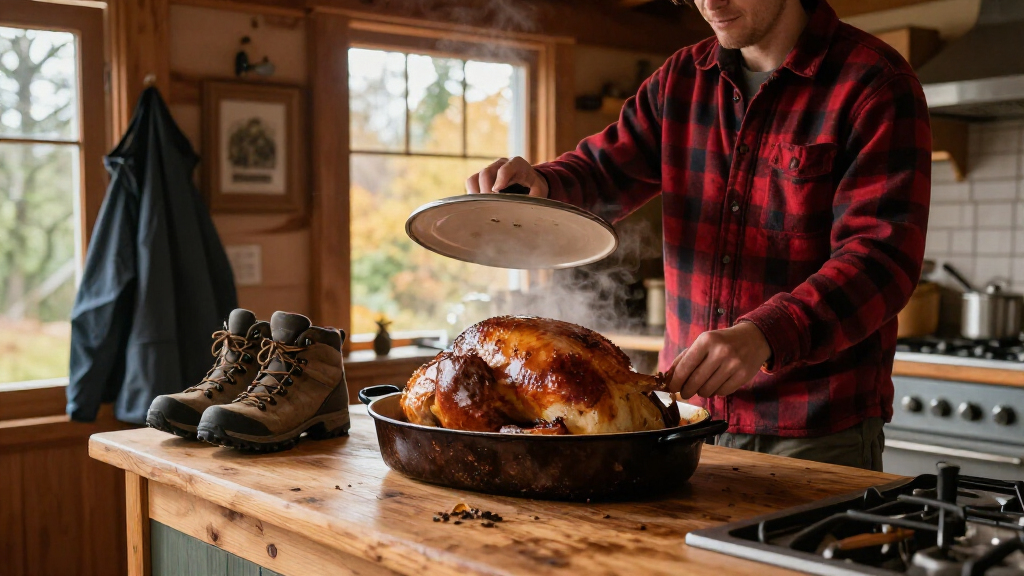
Begin checking about 30-45 minutes before the estimated end time. Carefully remove the lid, directing steam away from your face and hands. Insert a clean thermometer into the thickest part of the breast and the innermost part of the thigh without touching bone. Check the thickest area of the wing as well.
Tip: Steam trapped under the lid can burn. Lift the lid slowly and use dry oven mitts for a secure grip.
Check: You have clear temperature readings from the breast, thigh, and wing.
Step 6: Finish cooking to a safe temperature
Continue roasting and check again at short intervals until the breast, thigh, and wing each reach at least 165°F (74°C). If the turkey is stuffed, check the center of the stuffing too; it must also reach 165°F (74°C). Replace the lid between checks if the meat needs more time.
Tip: Do not rely on skin color, clear juices, or a pop-up timer alone. A thermometer gives the dependable doneness check.
Check: Every tested location reads at least 165°F (74°C), and any stuffing also reaches that temperature.
Step 7: Rest and carve
Transfer the turkey to a carving board, tent it loosely with foil, and let it rest for 20-30 minutes before carving. Keep raw-turkey tools and juices away from cooked meat. Carve with a clean knife and serve promptly.
Tip: Resting lets juices settle and makes carving easier. Do not leave cooked turkey at room temperature for more than two hours.
Check: The meat is fully cooked, rests before carving, and the slices are moist and easy to cut.
Common Mistakes to Avoid
- Using a pan or lid that is too small or not oven-safe. — Check interior dimensions, lid clearance, handle materials, and the manufacturer’s temperature rating before cooking.
- Estimating doneness from time or appearance alone. — Use a food thermometer in several thick areas and cook each to at least 165°F (74°C).
- Rinsing raw turkey or reusing its utensils for cooked food. — Pat the bird dry, wash hands and surfaces, and use clean tools and serving plates for cooked turkey.
- Opening the lid repeatedly or lifting it toward the face. — Check near the estimated finish and lift the lid slowly with dry mitts, directing steam away from you.
Troubleshooting
Problem: The turkey is not thawed when it is time to cook.
Solution: Keep it refrigerated until fully thawed. If using a cold-water thawing method, keep the bird sealed, submerge it in cold water, change the water every 30 minutes, and cook immediately after thawing.
Problem: The turkey is browning too quickly.
Solution: Keep the lid on and check the oven temperature with an oven thermometer. If the pan instructions allow, reduce the heat slightly while continuing to use internal temperature to judge doneness.
Problem: The breast is done but the thigh is below 165°F (74°C).
Solution: Return the turkey to the oven and continue cooking. Recheck the thigh and breast after a short interval; shield the breast loosely with foil if it is getting too dark.
Problem: The skin is pale or soft after covered roasting.
Solution: Once the turkey is safely cooked, remove the lid and brown the skin briefly under the oven’s broiler, watching continuously. Skip this if the pan or lid is not broiler-safe.
What Success Looks Like
The turkey is safely cooked when a food thermometer reads at least 165°F (74°C) in the thickest breast, innermost thigh, and wing, with stuffing at the same temperature if used. After a 20-30 minute rest, the bird should carve cleanly and remain moist. Refrigerate leftovers within two hours.
Next Steps
Serve the carved turkey, then refrigerate leftovers in shallow covered containers within two hours. Use refrigerated leftovers within 3-4 days or freeze them for longer storage. Let the pan cool before washing it according to the manufacturer’s care instructions; avoid abrasive cleaners if the finish is nonstick.
Frequently Asked Questions
Should I roast a turkey with the lid on the whole time?
Yes, if the pan maker allows it and the lid is oven-safe. Covered roasting helps retain moisture. Remove the lid near the end only if you want to brown the skin, and monitor the turkey closely.
How much liquid should I put in the pan?
Liquid is optional. If you add water or stock, use only enough to cover the bottom of the pan while keeping the turkey above it on a rack. Too much liquid can steam the bird and dilute drippings.
Can I use a disposable foil pan with a lid?
Use one only if its manufacturer rates it for the turkey’s weight and oven temperature. Foil pans can bend when full, so set the pan on a sturdy baking sheet before filling or moving it.
What if my roasting pan has no rack?
Use an oven-safe rack that fits the pan. If unavailable, arrange thick onion or carrot pieces under the turkey to lift it above the bottom and allow hot air to circulate.