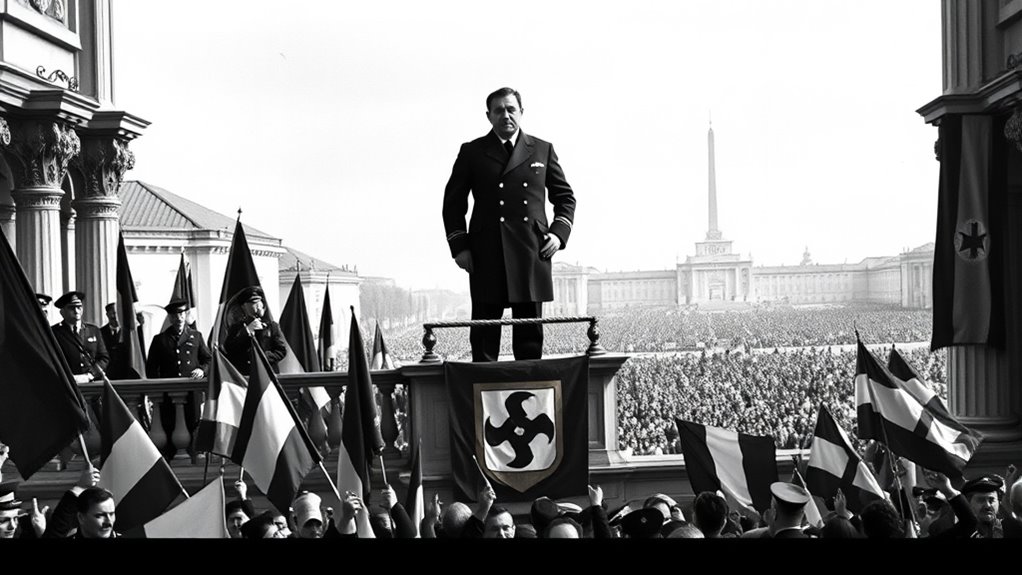

In 1925, Mussolini consolidates power by intensifying propaganda that glorifies his leadership and promotes national pride, making him appear essential for Italy’s greatness. He suppresses opposition using secret police, imprisoning critics and creating a climate of fear. At the same time, he forms alliances with military and industrial elites to legitimize his rule. These combined efforts ensure Mussolini’s control is unchallenged—continue to explore how he further strengthened his grip on Italy.
Key Takeaways
- Propaganda campaigns glorified Mussolini as Italy’s strong leader, shaping public perception and fostering loyalty.
- Political opposition, especially socialists and liberals, was suppressed through repression and secret police efforts.
- An environment of fear was established to discourage dissent and ensure obedience to Mussolini’s regime.
- Mussolini built alliances with the military and industrial elites to legitimize and strengthen his power.
- The combination of propaganda, repression, and alliances created a comprehensive system of control in Italy by 1925.

Benito Mussolini quickly solidified his control over Italy after rising to power, employing a combination of propaganda, suppression of opposition, and strategic alliances. As you observe his methods, it becomes clear that fascist propaganda played a vital role in shaping public perception. Mussolini’s regime flooded Italy with posters, newspapers, and speeches that glorified the fascist ideals, portraying him as the only leader capable of restoring Italy’s greatness. Through these efforts, he crafted a compelling narrative that emphasized unity, strength, and national pride, making it easier to manipulate public opinion and foster loyalty. The propaganda was relentless, ensuring that dissenting voices were drowned out and that his image remained dominant in the minds of the Italian people. Propaganda was a crucial tool in maintaining his authority and controlling the narrative.
Alongside this propaganda campaign, Mussolini’s regime enacted severe political repression to eliminate any threats to his authority. You’d notice that opposition parties, especially socialists and liberals, faced relentless persecution. Mussolini’s government used secret police, known as OVRA, to monitor, intimidate, and arrest political opponents. Many were imprisoned or exiled, and any form of protest was met with harsh penalties. This suppression created an environment where opposition was effectively silenced, leaving Mussolini’s regime unchallenged. The political repression wasn’t just about silencing critics; it was about establishing a climate of fear that discouraged resistance and fostered obedience.
Mussolini also strategically allied himself with influential groups and figures, consolidating power through alliances that further strengthened his grip on Italy. He cultivated relationships with the military and the industrial elite, ensuring their support by promising stability and economic growth. These alliances helped legitimize his rule and made it easier to implement his policies. As you follow his rise, you see how these alliances complemented his propaganda and repression strategies, creating a thorough system of control.
Top picks for "mussolini consolidat power"
Open Amazon search results for this keyword.
As an affiliate, we earn on qualifying purchases.
Frequently Asked Questions
How Did Mussolini’s Policies Impact Italy’s Economy in 1925?
Your economic policies in 1925 aimed to boost industrial growth, leading to increased production and employment. You implement measures that encourage private investment and control inflation, which stabilizes the economy. These policies foster a sense of national pride and confidence, fueling further industrial expansion. As a result, Italy experiences a period of economic growth, though some sectors face challenges from government intervention. Overall, your approach promotes industrial development and economic stability in 1925.
What Was the Public’s Reaction to Mussolini’s Rise to Power?
You might notice that the public sentiment was mixed; many Italians supported Mussolini’s strong leadership, seeing stability and national pride in his rise. Social reactions varied: some cheered his authority and reforms, while others feared the loss of democracy and civil liberties. Overall, Mussolini’s public image grew more favorable among his supporters, but dissenting voices remained, reflecting a divided society grappling with rapid political change.
How Did Mussolini Suppress Political Opposition During This Period?
Like a predator stalking its prey, Mussolini’s regime silenced opposition through harsh censorship tactics and the secret police. You see, he targeted political opponents, shutting down newspapers and imprisoning dissenters without fair trials. The secret police acted swiftly, ensuring no voice could challenge his authority. This ruthless approach transformed Italy into a one-party state, crushing any opposition before it could take root, making his power unbreakable.
What Role Did Propaganda Play in Consolidating Mussolini’s Control?
Propaganda played a vital role in consolidating Mussolini’s control by using media manipulation and patriotic symbolism. You see, he carefully crafted messages that glorified his leadership and Italy’s greatness, shaping public opinion. Through newspapers, speeches, and posters, he fostered nationalism and loyalty, making Italians see him as Italy’s rightful leader. This strategic use of propaganda helped suppress opposition by creating a unified, obedient society that celebrated his regime.
How Did Italy’s Foreign Relations Change After Mussolini’s Rise?
You’d think Italy’s foreign relations would flourish after Mussolini’s rise, but instead, diplomatic shifts and alliances formation take center stage, often with a twist of irony. Italy seeks new partners, yet Mussolini’s aggressive policies create tension. Alliances are formed, but they’re fragile, reflecting Italy’s desire to assert itself while risking isolation. It’s a calculated dance of diplomacy, where power and paranoia intertwine on the global stage.
Conclusion
By 1925, Mussolini firmly takes the reins, turning Italy into a one-man show. You’ve seen how he silenced opposition and manipulated the system to his advantage. Remember, sometimes a single hand can steer a ship into dangerous waters. As Mussolini’s grip tightens, be cautious about the price of power—what seems like control today might lead to trouble tomorrow. Stay aware, for history often repeats itself when leaders forget the lessons of balance.