

The Paris Agreement of 2015 is a global effort where almost every country commits to fighting climate change together. It sets shared goals for reducing emissions, supporting developing nations, and boosting climate resilience. Countries pledge to update their targets every five years, increasing ambition over time. Transparency and accountability are key, ensuring progress is shared openly. If you stay with us, you’ll discover how these commitments shape our planet’s future and what more can be done.
Key Takeaways
- The Paris Agreement unites nearly all countries to set shared climate action goals and limit global warming to below 2°C, ideally 1.5°C.
- It emphasizes climate finance, encouraging wealthy nations to support developing countries with funding, technology, and infrastructure.
- Countries submit nationally determined contributions (NDCs), which they can update every five years to increase climate ambition.
- Regular transparency and progress reports foster accountability and trust among nations in achieving climate commitments.
- It promotes ongoing innovation and adaptation efforts, recognizing climate change as an evolving challenge requiring continuous action.
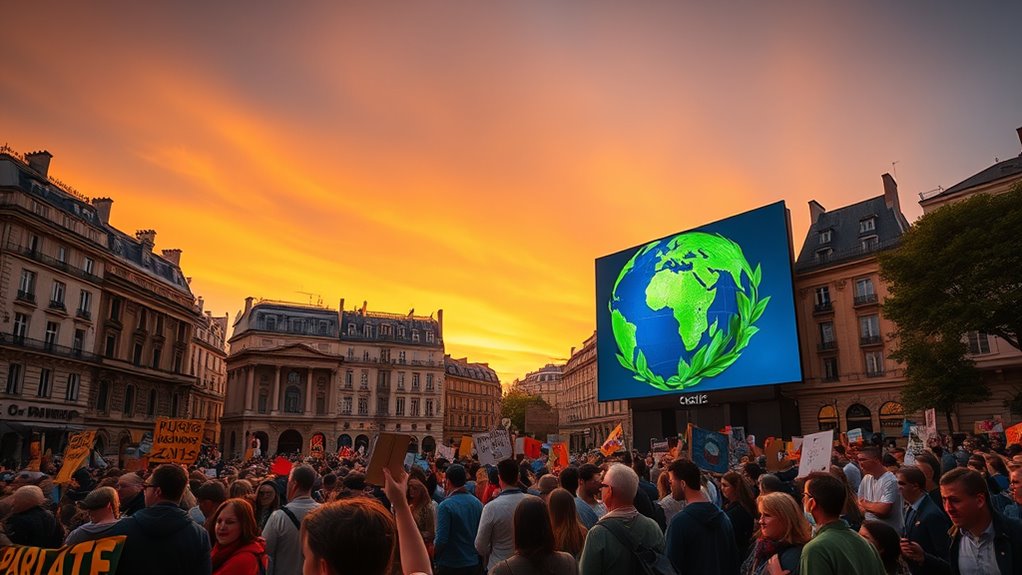
What makes the Paris Agreement of 2015 so significant in the fight against climate change? It’s because this global pact brought together almost every country to commit to collective action, recognizing that climate change is a shared challenge that needs shared solutions. Unlike previous treaties, the Paris Agreement set ambitious yet achievable goals for limiting global warming, with an emphasis on climate finance and emission targets. You see, climate finance plays a vital role here; it’s about mobilizing financial resources to help developing nations reduce their emissions and adapt to climate impacts. By pledging to provide financial support, wealthier countries acknowledged their responsibility to assist others in meeting their climate goals. This commitment guarantees that countries with fewer resources can access the technology and infrastructure needed to transition to cleaner energy sources and build resilience.
The core of the agreement revolves around emission targets, which serve as concrete benchmarks for countries to reduce their greenhouse gas emissions. These targets aren’t rigid mandates but are instead nationally determined contributions, or NDCs. This approach gives countries flexibility to set goals that match their capacities and circumstances, encouraging broader participation. As a participant, you’re empowered to take ownership of your country’s commitments, knowing that each nation’s efforts contribute to the global goal of limiting temperature rise to well below 2°C, ideally to 1.5°C. The importance of these targets lies in their cumulative effect; even if individual countries fall short, the collective effort can still make a meaningful difference.
Moreover, the Paris Agreement emphasizes transparency and accountability. Countries agree to regularly report their progress, fostering trust and encouraging continuous improvement. This transparency creates a system where everyone’s actions are visible, motivating nations to meet or exceed their commitments. For you, this means a global environment where nations are held accountable for their climate actions, creating a sense of shared responsibility. Additionally, advances in projector technology, such as higher resolution and better color accuracy, illustrate the importance of innovation in achieving large-scale environmental goals. The agreement also recognizes that climate change is an evolving challenge, so it encourages countries to update their emission targets every five years, aiming for greater ambition over time.
Top picks for "pari agreement global"
Open Amazon search results for this keyword.
As an affiliate, we earn on qualifying purchases.
Frequently Asked Questions
How Will Countries’ Climate Targets Be Enforced Under the Agreement?
You’re probably wondering how countries’ climate targets get enforced. Under the agreement, international monitoring tracks progress, making sure everyone stays accountable. Countries are encouraged to implement policies like carbon pricing to reduce emissions. While there aren’t strict penalties, transparency requirements and peer reviews promote compliance. This system relies on mutual trust and pressure, motivating nations to meet their commitments and work together towards global climate goals.
What Happens if a Country Fails to Meet Its Commitments?
If you fail to meet your climate commitments, you might face increased scrutiny through climate litigation, holding your country accountable. You could also be encouraged to improve efforts via carbon offsetting, balancing out emissions. While no strict penalties exist, persistent failure can harm your international reputation and diplomatic relations, making it harder to negotiate future agreements. You’re expected to continually enhance your climate actions, promoting transparency and accountability.
Are There Financial Penalties for Non-Compliance?
You won’t face direct financial sanctions or penalty mechanisms if you don’t meet your climate commitments, as the Paris Agreement relies on voluntary cooperation rather than strict enforcement. However, non-compliance can damage your country’s reputation, affect international relations, and potentially lead to increased scrutiny or pressure from global partners. While there are no formal penalties, the agreement encourages transparency and ambition, motivating countries to fulfill their commitments voluntarily.
How Does the Agreement Address Climate Adaptation Strategies?
You’ll find that the agreement emphasizes building climate resilience through adaptation strategies. It encourages countries to develop and implement adaptation plans, supported by adaptation funding. This funding helps vulnerable communities strengthen their infrastructure and reduce climate risks. By prioritizing climate resilience, the agreement aims to guarantee nations are better prepared for climate impacts, fostering sustainable development and protecting ecosystems. Your active participation in adaptation efforts is vital for global climate stability.
What Role Do Non-State Actors Play in the Agreement’s Implementation?
You play a vital role in the agreement’s success, as non-state actors like civil society and the private sector drive real change. Your actions, from advocacy to innovative projects, amplify climate efforts and hold governments accountable. Without your involvement, the fight against climate change would be like battling a mountain with a spoon. Together, you’re essential in turning commitments into tangible progress and ensuring a sustainable future.
Conclusion
By committing to the Paris Agreement, you join over 190 countries aiming to limit global warming to well below 2°C. Did you know that these nations represent nearly 99% of the world’s greenhouse gas emissions? This shows the significant collective effort needed to combat climate change. Your support and action are crucial in making this global commitment a reality, helping protect our planet for future generations.